
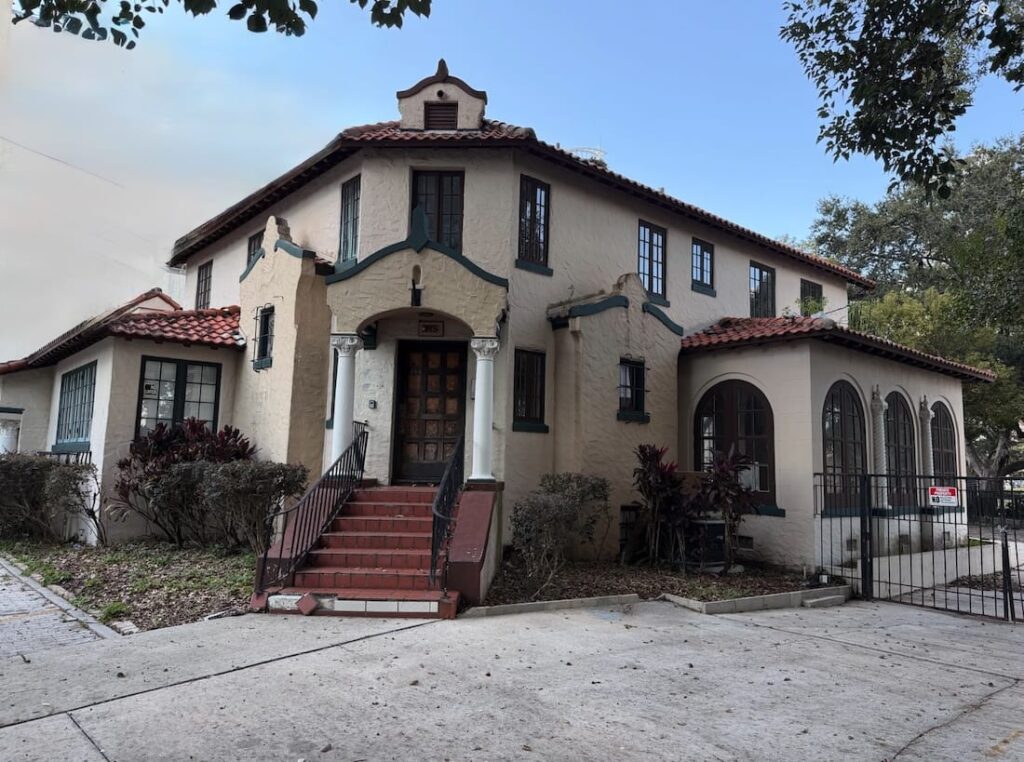
Two historic homes still stand on Lake Eola's shores. One became a beloved event venue. The other, the Lubbe House, might get demolished by the city that just bought it.
The Lubbe House at 215 E. Central Boulevard tells a story that's becoming all too familiar in rapidly growing Orlando.
Imagine it's around 1927-1930, and you're building your dream house on Lake Eola. Not near the lake. Not with a view of the lake. Directly on it. Your backyard is literally Orlando's postcard. Your morning coffee comes with swan sightings. You've made it.
That's exactly what the Lubbe family did, and their Mediterranean villa, complete with hurricane-proof tiles shipped from Holland, is still standing 95 years later. It's survived everything Florida could throw at it: hurricanes, humidity, real estate booms, real estate busts, and approximately one million Instagram photoshoots at Lake Eola.
While the Lubbe House remained a private family home all the way until March 2025, it might not survive the city's latest plan for a park expansion.
Meanwhile, its older neighbor, the Eola House, built in 1924, got the fairytale treatment: purchased by the city in 2013, beautifully restored, and transformed into Lake Eola Park's offices and a popular event venue. One house got saved. The other's facing demolition. Go figure.
Table of Contents
Quick Facts About the Lubbe House
- Built: 1927-1930 (many conflicting reports on the exact year)
- Location: 215 E. Central Boulevard, Orlando, FL
- Architect: Peter Cornelius Samwell
- Architectural Style: Mediterranean and Moorish Revival
- Original Materials: Hurricane-proof Dutch roof tiles, original window glass and woodwork
- Status: Purchased by Orlando's Community Redevelopment Agency in March 2025 for $2.54 million
- Historical Significance: Last surviving private residence on Lake Eola shores
- Current Threat: Under consideration for demolition for park expansion project
Peter Samwell: The Architect Behind the Lubbe House
Here's where the Lubbe House story gets interesting. This historic Orlando home wasn't designed by some local contractor trying to cash in on Florida's 1920s building frenzy. The architect was Peter Cornelius Samwell, a Dutchman whose professional credentials read like an architectural flex.
Before landing in the Orlando area, Samwell worked in the offices of Petrus J.H. Cuypers (yes, the guy who designed Amsterdam's Rijksmuseum, you know, that museum) and Hendrik P. Berlage (the Amsterdam Stock Exchange). Basically, he trained with European architecture royalty before deciding to bring those skills to Central Florida.
The result? A house with Mediterranean and Moorish styling, original window glass that's somehow survived since 1930, and those imported Dutch roof tiles engineered to laugh at hurricanes. The interior woodwork is still intact. After 95 years. In Florida. Where humidity destroys everything.
Samwell's other local masterpiece, the Park Plaza Hotel in Winter Park from 1922, is still a landmark. The man knew what he was doing.
When Lake Eola Was Residential (Yes, Really)
The land came from James Thornton, whose name still decorates street signs around Thornton Park, one of Orlando's oldest historic districts. Thornton was the developer who subdivided what became the Thornton Park neighborhood, and he sold the prime lakefront parcel to the Lubbe family. Back then, lakefront lots were the ultimate flex.
Quick sidebar on Lake Eola history: It started as a sinkhole on cattle baron Jacob Summerlin's property in the 1880s. The Summerlin family donated the land around it to the city in 1883, and boom, Orlando had its defining public space by 1888. By the time the Lubbe House went up in 1930, Lake Eola Park had become Orlando's civic heart.
Newspapers at the time called it "one of the outstanding homes of Orlando," which is old-timey journalism speak for "someone important lives here and we're impressed."
The house stayed in private hands for decades, an actual family home where people lived, not a commercial property or apartment building. The Scotts were the most recent owners before the city swooped in.
The $2.54 Million Question
In March 2025, the Orlando Community Redevelopment Agency bought the Lubbe House and a neighboring property for about $2.54 million. The goal: create a gateway to Lake Eola Park and add more recreational and commercial space at the southwest corner of the historic park.
Early concepts for the Lake Eola gateway project included keeping the historic house and working it into the design. City Commissioner Patty Sheehan said she got assurances it would be preserved. Great news, right?
Well, not so fast. More recent discussions have floated the idea of demolishing it to make room for a bigger restaurant or commercial building. Because apparently, what Lake Eola really needs is another place to buy overpriced smoothies. (Okay, we don't actually know if it's smoothies, but you get the point.)
Orlando Historic Preservation Advocates Enter the Chat
This is where the Orange Preservation Trust, a nonprofit dedicated to historic preservation and revitalization of Orange County's historic resources, stepped in. They've filed for official Landmark Designation for the Lubbe House, arguing that landmark status would recognize the building's architectural and historical significance while still letting the city get creative with park plans.
Here's the thing about historic landmark designation: it doesn't mean the building gets frozen in amber forever. The city could still change how it's used, even add on to make it bigger. The designation just means you can't demolish it without really, really good justification and proper process.
The fate of the historic Orlando home now rests with city officials and preservation advocates working through the designation process.
Why the Lubbe House Actually Matters
Here's what makes the Lubbe House special beyond the "old building with fancy architect" angle: It's the last one that stayed a home.
Yes, the Eola House from 1924 still stands, and it's gorgeous, restored, and thriving as an event space. But it transitioned from private residence to public/commercial use back in 2013. The Lubbe House? It remained somebody's actual house, where people lived, raised families, had breakfast, watched storms roll in, all the way until March 2025.
That makes it the last survivor of Lake Eola's residential era. Every other private home that lined the lake's shores either got demolished, replaced, or transformed into something else. This historic building is the only physical reminder that Lake Eola wasn't always just for tourists, joggers, and swans. It was someone's backyard.
Plus, there's something poetic about a house designed by a guy who learned his craft at the Rijksmuseum surviving almost a century in a state that regularly tries to destroy everything with hurricanes, termites, and aggressive humidity. Those Dutch tiles? Still doing their job.
The Bigger Picture for Orlando Historic Preservation
The struggle over the Lubbe House represents a familiar tension in rapidly growing cities: how to balance development and progress with preservation of irreplaceable historic fabric. Can Orlando have both expanded recreation space and its last lakefront home? That's the challenge city planners face.
For historic preservation advocates, this is about more than one building. It's about whether Orlando makes room for its architectural history or just bulldozes it whenever development plans change. The Eola House proved that preservation and adaptive reuse can work beautifully, the city saved it, restored it, and gave it new purpose as a thriving event space. The question is whether the Lubbe House gets the same chance.
For the Lubbe House itself, which remained a family home longer than any other structure on Lake Eola, it's a question of whether the building that survived 95 years of Florida weather can survive something even more unpredictable: changing priorities in city planning.
The Lubbe House has outlasted hurricanes, economic crashes, and nearly a century of Florida's relentless climate. Whether it outlasts Orlando's development ambitions, and earns the same historic preservation treatment as the Eola House, remains to be seen.
Love Orlando History? We've got you! See our archive, right here.
Sources:
- https://redevelopment.net/2026/01/local-preservation-group-wants-to-save-historic-lubbe-house/
- https://orlandoshine.com/local-preservation-group-wants-to-save-historic-lubbe-house-from-chopping-block-ahead-of-possible-park-expansion/
- https://bungalower.com/2026/01/29/preservation-advocates-urge-support-for-historic-lubbe-house-on-lake-eola/
- https://www.facebook.com/groups/New.Historic.Orlando/posts/4186615931648394/
- https://www.orlandoweekly.com/news/petitioners-file-appeals-opposing-planned-high-rise-near-lake-eola-2427716/