Most buildings pick a lane. They’re an office. A restaurant. Maybe a bank that becomes a bar. The Kress Building in downtown Orlando looked at all those options and said, “Yes, all of them, please, and throw in some jousting.”
Since the 1930s, this Art Deco gem at 15 West Church Street and 124 South Orange Avenue has been a five-and-dime department store, a segregated lunch counter that became a civil-rights battleground, a medieval-themed dinner theater with actual goblets of ale, and today a high-end chophouse with office space upstairs.
Through every incarnation, the same glazed terra cotta parrots have kept watch from the façade, unbothered, eternal, judging no one.
It’s the best building in Orlando that most people walk right past. Let’s fix that.
Table of Contents
The Guy Who Thought Dime Stores Should Be Gorgeous: The Origin of the Kress Building
Samuel Henry Kress was born in 1863 and grew up to do something deeply weird for a discount retailer: he cared about architecture. Like, a lot.
Starting in the 1890s, Kress built S. H. Kress & Co. into a national empire of “5-10-25 Cent Stores,” hundreds of locations hawking household goods, clothing, candy, and notions at bargain-bin prices. The business model was simple: sell cheap stuff in enormous quantities.
But here’s where Kress went off-script. He wanted every store to be a “work of public art.” While his competitors were throwing up forgettable storefronts, Kress was commissioning buildings that looked like they belonged on postcards.
In the late 1920s, he hired New York architect Edward F. Sibbert as the company’s in-house designer. Sibbert went on to design more than 50 Kress stores across the country, each a sleek mashup of Art Deco and Art Moderne.
Orlando got one of his best.
Parrots, Sunbursts, and Serious Flair: The Kress Building’s Architecture
Let’s talk about the parrots. Because you cannot talk about this building without talking about the parrots.
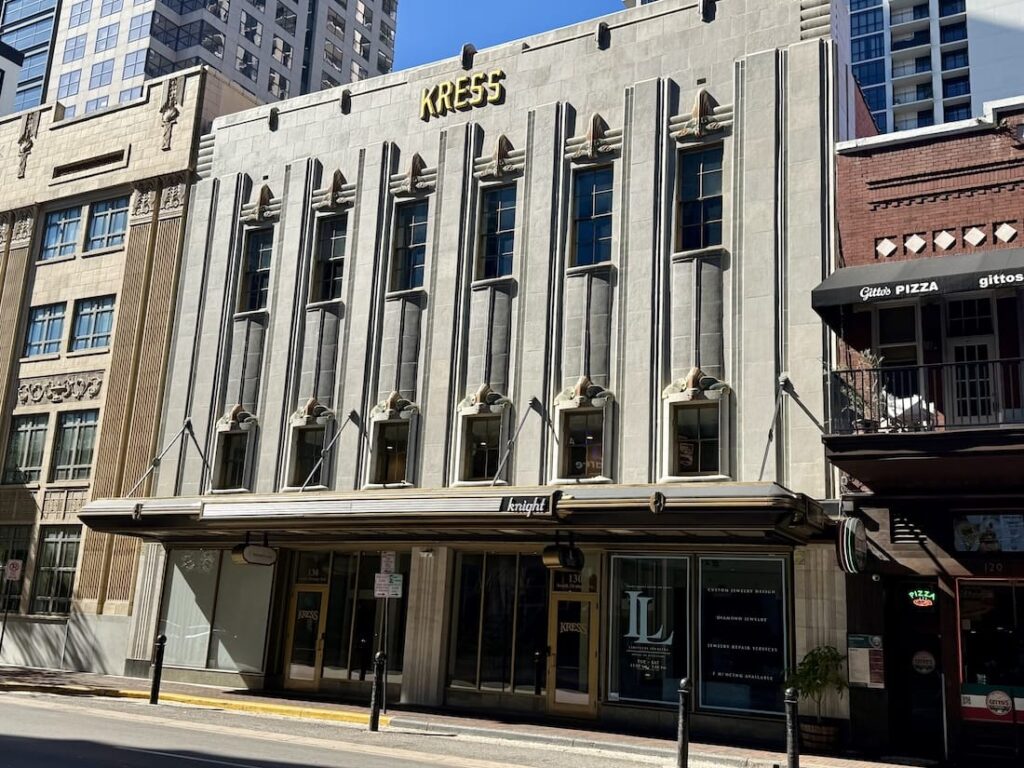
Ask Orlando's preservation office to name the single best Art Deco building downtown, and they'll point you here because the city has precious few of them, and none wear the style this well. Architect Sibbert built it with masonry over steel-reinforced poured concrete, then dressed it in glazed terra cotta facades with a granite base.
The Orange Avenue side wears off-white terra cotta; the Church Street side uses similar coloring but in brick, a subtle distinction that reflected how the two streets operated differently in the 1930s.
But the real showstoppers are the polychrome terra cotta panels. Stylized parrots in flight poses surround the upper windows. Perched parrots decorate the lower window surrounds. Between them, “cloud” and sunburst motifs pop in pastel colors. The whole thing reads like a tropical fever dream executed by someone with impeccable taste and a very steady hand.
So why parrots? Best theory: Florida’s parrot jungles were huge tourist draws in that era, and, this is the fun part, “birds and accessories” was an actual listed product category in Kress store inventories. The parrots were simultaneously a love letter to the Sunshine State and an advertisement for aisle seven.
Building a Dime Store During a Depression
Sibbert drew up the plans. The G. A. Miller Company did the building. City records and UCF’s RICHES archive agree that construction started around 1930, with the store officially opening in 1936. Some local sources say “built 1935,” but the gap tracks with a known Kress habit of starting buildings well before finishing the interiors.
Now, the money part, because this is where it gets wild. When S. H. Kress & Co. opened the Orlando store, the company signed a 99-year lease valued at approximately $594,000 on a building that cost roughly $250,000 to construct. During the Great Depression. That’s the corporate equivalent of going all-in before the flop. Kress clearly believed downtown Orlando had a future.
Soda Fountains and the Kress Building’s Downtown Heyday
For the next two decades, the Kress store hummed along exactly as planned. Inexpensive household goods, clothing, notions, and, crucially, a lunch counter or soda fountain that turned a shopping trip into a social event. Before suburban malls existed, this was where you ran into your neighbors, caught up on gossip, and maybe bought a spatula.
The building’s corner location and eye-catching façade helped anchor Orlando’s business district during the same years that taller neighbors, the Angebilt Hotel, the Metcalf Building, were pushing the skyline upward. The Kress didn’t need height. It had parrots.
When a Lunch Counter Became a Battleground
Here’s where the story gets serious, and it should.
Like every national chain operating in the Jim Crow South, Kress enforced racial segregation at its lunch counters. Across the region, those counters became flashpoints for the civil-rights movement, and Kress shows up repeatedly in civil-rights case law—not because the company was uniquely cruel, but because its stores were everywhere and its counters were impossible to ignore.
In March 1960, Black residents in Orlando staged at least two sit-ins at the Kress lunch counter to protest its whites-only policy. According to research from the City District and the Orange County Regional History Center, the protests remained nonviolent. Management’s response? They yanked the stools out entirely so nobody, Black or white, could sit down.
It was petty, it was cowardly, and it was a tactic pulled straight from the Jim Crow playbook in cities across the South.
It didn’t hold. By September 1960, some downtown Orlando lunch counters, including the one inside the Kress Building, had begun to integrate. A parrot-covered dime store had become a small but real stage in the fight for civil rights.
That layer of history deserves to be remembered every time someone admires the terra cotta.
Corporate Shuffles and the End of the Kress Building’s Dime-Store Days
The 1960s brought trouble for Kress the brand. In 1964, Genesco, Inc. bought the company and started migrating stores from downtowns to suburban shopping centers,a move that mirrored what was happening to Main Streets everywhere. Through the 1970s, historic Kress buildings across the country went dark. McCrory purchased the remaining Kress stores in 1981 and eventually shut the whole operation down.
In Orlando, the Kress store vacated the building in 1975, wrapping up roughly four decades as a five-and-dime. The parrots stayed. The people left.
Landmark Status and the Kress Building’s Preservation
Luckily, preservationists had been paying attention. In 1978, just three years after Kress walked away, the City of Orlando designated the Kress Building an official Orlando Historic Landmark, citing the Art Deco design and its place in downtown’s commercial history.
Then in 1980, Orlando created the Downtown Historic District, its only historic district made up primarily of commercial buildings. The Kress Building was singled out as an “excellent example” of modernistic Art Deco architecture within a streetscape otherwise full of classical and Mediterranean-influenced facades. Translation: it was the cool kid on a block full of sensible khakis.
That landmark status has protected the façade through every tenant change, renovation, and real-estate trend since.
King Henry, Chophouses, and the Kress Building’s Many Second Acts
After Kress departed, things got... creative.
The Church Street portion of the building, the leg of its L-shaped footprint, became home to King Henry’s Feast, a medieval-themed dinner attraction with jousting, wench humor, and tankards of ale. (This actually happened. Inside an Art Deco building decorated with parrots. Orlando is a magnificent place.)
King Henry’s eventually migrated to International Drive, and the space cycled through a rotating cast of shops and restaurants as Church Street Station and downtown nightlife did their 1980s and 1990s thing.
Through all of it, the terra cotta survived. The parrots endured. Nobody was allowed to tear anything down, and the city’s preservation office kept pointing to the Kress Building as Exhibit A for how adaptive reuse is supposed to work.
Today, the Church Street side houses Kres Chophouse, a high-end steakhouse that leans hard into the historic vibe. The Orange Avenue side has hosted office and innovation space, including a run as home to the UCF-affiliated Starter Studio business incubator.
And in 2022, the Orlando City Council approved roughly $90,000 in redevelopment grants to spruce up the building’s exterior, canopies, glass, paint, and other façade work, specifically to preserve the Art Deco character while keeping the place attractive to modern tenants. Even city government can’t resist the parrots.
Ghosts, UFOs, and Other Things the Kress Building Allegedly Contains
Because no building this old and this prominent gets through a century without collecting supernatural baggage, the Kress Building has a reputation on the ghost-tour circuit. Tour companies regularly list it among downtown Orlando’s “most haunted” locations, spinning tales of mysterious footsteps, shadowy apparitions, and, this is the good one, a former resident who was supposedly obsessed with UFOs.
These stories come from commercial ghost-tour operators, not from any archive or public record, so file them firmly under “urban legend.” But the fact that people keep inventing folklore about the building tells you something: it’s been planted in the city’s imagination for so long that Orlando has started making up bedtime stories about it.
How to Actually Look at the Kress Building (A Walking Guide)
If you’re downtown, and you should be, give the building five minutes on foot. It’s worth it.
Start on Orange Avenue and take in the primary Art Deco façade. Notice the vertical pilasters, the massing, the rhythm of the stacked window bays. This is the “dress shirt” side of the building, formal, composed, meant to impress.
Then walk around to Church Street and look up. This is where the parrots live. Upper-story birds are frozen mid-flight. Lower-story birds perch calmly on the window surrounds. Between them, cloud-and-sunshine motifs glow in pastel colors that feel like they belong on a vintage Florida postcard.
Stand there long enough and you can picture the whole timeline: the crowded 1930s dime store with its soda fountain, the tense March afternoon in 1960 when students sat down at a counter that refused to serve them, the King Henry’s Feast era with its foam swords and turkey legs, and the chophouse crowd clinking glasses today. Every chapter is stacked inside the same shell of brick and glazed clay.
The Kress Building was never the tallest thing in downtown Orlando. It was always the most interesting. And the parrots, frankly, have been trying to tell you that for ninety years.
🔥 Love Orlando history? Check out tons more, right here.
Sources:
https://citydistrictorlando.com/kress-store/
https://richesmi.cah.ucf.edu/omeka/items/show/1696https://en.wikipedia.org/wiki/S._H._Kress_%26_Co. https://www.orlando.gov/files/sharedassets/public/v/1/departments/edv/city-planning/historic-preservation/2015-calendar-for-web-1.pdf
https://www.orlando.gov/files/sharedassets/public/v/1/departments/edv/city-planning/historic-preservation/final-proof_2017-calendar-1.pdf
https://www.orlando.gov/Our-Government/History/Historic-Preservation-Districts
https://thecraftsmanblog.com/orlando-historic-districts-downtown/
https://www.kressdaytona.com/story/index
https://www.foundrycommercial.com/property/kress-building/
https://orlandohaunts.com/the-kress-building/