If you live in Orlando or Winter Park, you've probably ridden the Dinky Line without knowing it. That paved bike trail behind your neighborhood, the goofy angle of the Cady Way Pool, the little waterfront park where Rollins students launch paddleboards on a Saturday morning, all of it traces back to a rickety narrow-gauge railroad that hauled tourists, citrus, and college kids between downtown Orlando and Oviedo for the better part of 80 years.
It was slow, smoky, almost always late, and famously prone to falling off its own tracks. And locals adored it anyway. People who grew up here in the 1950s and 1960s still talk about it like an eccentric great-uncle.
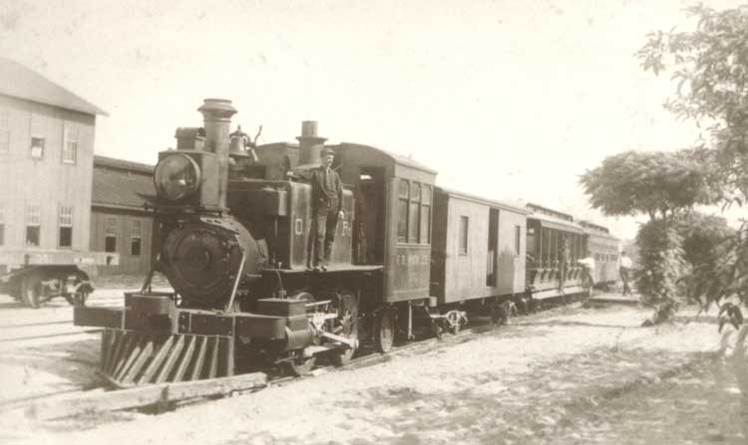
Formally known as the Orlando and Winter Park Railroad, the Dinky Line ran its first train on January 2, 1889 and its last on October 22, 1967. In between, it stitched together a chain of lakes that still shapes how Central Florida looks, moves, and (in at least one delightfully weird case) where our swimming pools point.
Table of Contents
How a Yellow Fever Outbreak Almost Killed the Project
The idea came from J. Harry Abbott, a local promoter who in 1886 looked at the booming citrus town of Orlando and the genteel resort village of Winter Park six miles north and thought, somebody should put a train between these two places. The official plat was recorded in May 1887, and then almost everything that could go wrong did. Contractors dragged their feet. Money got tight. And then yellow fever swept through Florida and ground construction to a complete halt for the better part of a year.
The project survived mostly because of Francis B. Knowles, a wealthy New Englander who refused to let his pet project die and who happened to be one of Winter Park's most important early backers. Under his stubborn leadership, the railroad finally opened on the morning of January 2, 1889. The return trip that same day was mostly uneventful, except for the part where two of the coaches jumped the tracks before reaching Orlando. Nobody was hurt. The passengers just laughed it off, which, honestly, set the tone for the next eight decades.
The Route: A Lake-by-Lake Tour of Old Orlando
The original line covered just six miles and took roughly half an hour, which is about the same time it takes to drive 17-92 today during rush hour. Make of that what you will. From the South Florida Railroad station on Central Avenue in downtown Orlando, the train rolled past the city's old electric plant and went looking for water. The route basically traced the shoreline of every significant lake between the two cities, which made for a beautiful ride and, predictably, a frequently late one.
Stops and landmarks along the way included:
- Lake Ivanhoe and Lake Highland (first stop: Fair Oaks)
- Lakes Formosa, Estelle, and Rowena. The Rowena stop sat near today's Princeton Street and Highway 17-92
- Lake Sue, through land that would later become Mead Gardens
- The western shore of Lake Virginia, cutting straight across the Rollins College campus
- A grand Victorian depot at the foot of Ollie Avenue in Winter Park. That site is now Dinky Dock Park
Tracks were laid right through the Rollins College campus in March 1889, which meant Orlando students could suddenly take the train to school instead of riding horseback into Winter Park every morning. Imagine being the freshman who got to brag about that. The college stop was just a small platform, but the Ollie Avenue depot was an ornate Victorian building that wouldn't have looked out of place in New England. That same patch of grass is now the waterfront park where Winter Parkers launch kayaks every weekend. Same spot, different century.
Why the Dinky Line Got Its Nickname
Abbott originally tried to brand his creation the "Scenic Road," which sounds like it was workshopped by exactly one person. The name never stuck. The label that did came from Rollins College students, who started calling it the Dinky Line. They meant it as a roast.
And "dinky" was painfully accurate. The train was small. It topped out around 6.5 miles per hour, which is jogging speed. It was almost always late. The sandy Florida soil gave it what a 1967 edition of the Rollins Sandspur called a "remarkable ability to leave the tracks." Picture a train that derails the way a shopping cart wobbles off course in a parking lot.
Students nicknamed the two steam engines Tea Pot and Coffee Pot. The train itself was the Little Wiggle, which is somehow the most affectionate name anyone has ever given a piece of freight equipment. Pranksters would grease the tracks with oil or soap so the crew had to climb down and shovel sand under the wheels just to get moving again. The Dinky Line was a punchline on wheels, and everyone secretly loved it.
Eight Trips a Day, Fifteen Cents a Ride
At its peak, the line ran up to eight round trips per day, and a one-way ticket cost a princely 15 cents (the early-1900s equivalent of about five bucks today). The train was built to ferry northern tourists to the Seminole Hotel on Lake Osceola, which at the time was one of the largest wooden hotels in the United States. Picture a place so big it had its own weather. It also carried Rollins students and the small but growing number of people who lived between Orlando and Winter Park year-round.
It was built to three-foot narrow gauge, which was cheaper to lay through Florida's sandy, lake-pocked terrain. The trade-off was that the line was inherently wobbly, hence all those derailments. It never electrified the way fancier interurbans of the era did, partly because nobody could justify the cost for six miles of track. It ran on steam until it ran on diesel, and then it ran on diesel until it didn't run at all.
Reaching Oviedo and Beyond
By 1891, the line had stretched eastward to Oviedo, threading through Goldenrod and the picnic fields in between. The route followed a survey done by Orange County Surveyor John O. Fries the year before, hugging the south side of Lake Mizell and crossing what is now Ward Park. Through a merger with the Osceola and Lake Jessup Railway, it eventually reached Lake Jesup, which back then was a serious commercial waterway.
Orange County maps from 1920 still showed train stops at Winter Park, Goldenrod, Gabrielle, and Oviedo. A spur line crossed what is now Cady Way Park, and here's the fun part: the angle of that vanished spur is the reason the Cady Way Pool sits at its oddly skewed orientation today. The railroad is long gone. Its geometry refused to leave.
Who Actually Owned the Thing
After Francis B. Knowles died in May 1890, ownership started shuffling, the way small railroads of the era tended to. On April 9, 1891, the Orlando and Winter Park Railway merged with the Osceola and Lake Jessup Railway to form the East Florida and Atlantic Railroad. By 1894, the whole thing had been folded into the Florida Central and Peninsular Railroad. Five years after that, in 1899, the Seaboard Air Line Railway (SAL) bought the Florida Central and Peninsular and took over operations the following summer. For a six-mile lake-side jaunt, this train somehow accumulated an MBA's worth of corporate paperwork.
Through every corporate change, the railroad kept running on the same tracks, through the same backyards, at the same speed. As passenger traffic faded, the freight that kept it alive was citrus, the same crop that built half the houses it rumbled past.
The Quiet Death of the Dinky Line
By the 1960s, the world this little railroad had been built for was long gone. The pine woods around Lake Highland and Lake Estelle had been carved into some of the most expensive residential lots in Winter Park, and the homeowners on those lots were, to put it gently, not thrilled to have a freight train chugging through their front yards at the crack of dawn. The city council was hearing about it. Often. And in pointed language.
A July 1960 editorial in the Orlando Evening Star described a Seaboard locomotive "pulling a string of freight cars, in the front yard of a home in one of Winter Park's best residential sections," and bluntly called for the line to be shut down. By then, the train was running only once a day, basically as a courtesy.
The final run took place on October 22, 1967. Around 600 passengers paid for a sentimental ride from Orlando to Oviedo, leaving downtown at 9:30 a.m. on a Sunday morning to a mix of cheers and waved handkerchiefs. The tracks were pulled up by 1969. Almost 80 years of Central Florida history came up with the spikes.
Where the Dinky Line Lives Today
Here's the thing locals miss: the railroad never really left. Right-of-way corridors are too valuable to abandon, and the path of least resistance through a city, once carved, tends to stay carved. The old corridor is still there. You just can't see the rails anymore. They've been replaced with asphalt, joggers, dog walkers, and very determined Saturday-morning cyclists in matching team kits. The route is doing the same job it always did, moving people between Orlando and Winter Park, just with very different vehicles.
Modern features sitting directly on the old footprint include:
- The Cady Way Trail, a 7.5-mile paved path that opened in 1994 and now logs more than half a million users a year
- The Cross Seminole Trail, which follows the northeastern leg of the old Aloma Branch
- Sections of the Orlando Urban Trail, which winds through downtown along the original route
- Dinky Dock Park on Lake Virginia in Winter Park, sitting on the exact spot where the old Victorian depot used to be
If you've ever biked Cady Way on a Saturday morning, kayaked off Dinky Dock, or wondered why a sidewalk in your neighborhood cuts through at an angle that ignores every property line, congratulations: you've been using it. The trains stopped, but the route they cut through Central Florida is still moving people between Orlando, Winter Park, and Oviedo. Just on two wheels instead of two rails.
So next time you're out for a walk or a ride and the trail bends in a way that makes absolutely no sense, look around. That's a 137-year-old decision you're following. The little narrow-gauge railway was small, slow, smoky, and famously prone to derailing, and nearly 60 years after the last whistle, it's still quietly bossing this city around.
🔥 Want more Orlando history? Well, there's plenty more where this came from, right here.
Sources:
https://winterparklibraryarchives.org/exhibits/show/histbisref/the-dinky-railroad
https://www.facebook.com/thehistorycenter/posts/the-dinky-line-the-narrow-gauge-railway-that-ran-initially-between-orlando-and-w/10156249809771154/
https://richesmi.cah.ucf.edu/omeka/items/show/748
https://www.frrandp.com/2020/11/the-orlando-winter-park-railway.html
https://citruslandfl.blogspot.com/2016/08/the-orlando-winter-park-no-dinky-line.html
https://orlandomemory.org/topics/seaboard-air-line-railroad/
https://floridahikes.com/cady-way-trail/
https://orlandoretro.com/2014/01/24/commuter-rail-before-sunrail/