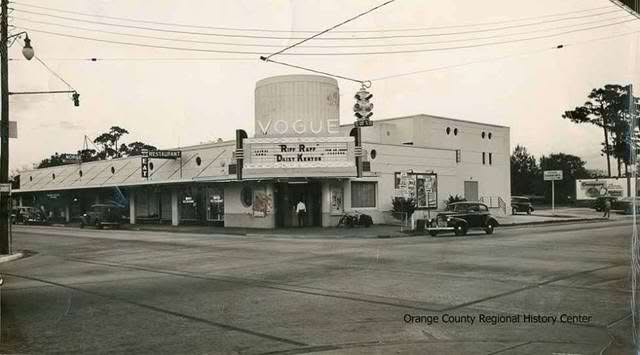
The Vogue Theatre had 900 seats, a wall of glowing stained glass, and the distinct honor of being one of the few Orlando businesses ever ordered by a federal judge to stop being terrible. Not bad for a movie house that opened on Christmas Day and, three decades later, quietly went out with X-rated features and a busted back door.
Today its exact footprint is a CVS on the corner of Colonial Drive and Mills Avenue, which is a deeply unglamorous fate for a building that helped give the Mills 50 district its name.
If you live in greater Orlando and have ever waited in that pharmacy line, you have been standing on top of one of the neighborhood’s best stories and had no idea. Let’s fix that.
Table of Contents
A Christmas Day Premiere in Old Colonialtown
The story of the Vogue Theatre begins on December 25, 1940, when Sparks Theaters unwrapped a brand-new picture palace at 1201 E. Colonial Drive. Opening a movie house on Christmas Day is a bold flex, but the debut feature, Four Mothers starring Priscilla Lane, pulled a holiday crowd into what was then called the Colonialtown neighborhood. Sparks, a regional circuit tied to Paramount Pictures, was clearly betting big on this corner.
The company even opened a second venue, the Cameo Theatre, just one block west that same year. The Cameo lasted about as long as a New Year’s resolution, closing for good in 1941.
The building was pure Streamline Moderne, the sleek, curving style that made Depression-era Americans feel like the future had finally shown up. Rounded corners, clean horizontal lines, and a crisp modern facade set it apart from the older masonry storefronts nearby. There was no balcony, just 900 seats on a single level.
The detail longtime patrons still swoon over is the row of stained glass panels along the side walls, lit from behind so the whole auditorium shimmered with a jewel-like glow. That is a shockingly fancy touch for a second-run house. The floor plan was pure oddball, too.
After buying a ticket, you walked forward roughly 100 feet, then hooked north to reach the main auditorium, a zigzag forced on the place by the cramped corner lot at Colonial and Mills.
The Life and Times of the Vogue Theatre Under Florida State Theatres
In 1942, Sparks reorganized and rebranded as Florida State Theatres, the corporate umbrella that would run the Vogue Theatre and dozens of other Central Florida screens. In the jargon of film distribution, this was a “21-day theatre,” which is a polite way of saying a movie showed up exactly three weeks after it played the fancy downtown houses. Nobody was walking a red carpet here. This was the affordable, walkable, catch-it-when-it-gets-here option for Colonialtown families who just wanted a night out close to home.
Those were the glory days. Through the late 1940s and 1950s the Vogue Theatre held onto a loyal crowd. It was independently run rather than part of some national chain, and it worked as a genuine community hub, the kind of place where you bumped into half your neighbors on a Friday night.
One former patron recalled Saturday morning children’s showings in the early 1950s branded as the “Great Big Armstrong Club,” a classic bit of era-appropriate marketing packed with cartoons, serials, and prizes to reel kids in. Admission ran a single quarter, cheap enough that a determined child could fund it entirely on returned soda bottles.
By the mid-1950s the Colonialtown and Mills corridor had become one of Orlando’s first big retail strips outside downtown, riding a postwar boom powered in part by the nearby Orlando Army Air Base and a city that was growing fast.
The Civil Rights Case That Made Legal History
The most consequential chapter in the life of this movie house unfolded in the mid-1960s, and it is the reason this corner deserves a permanent place in Orlando’s civil rights history. Segregation was still the everyday reality across much of the South, and Central Florida was no exception. On August 1, 1964, barely a month after the Civil Rights Act took effect, a Black couple named John V. Twitty and Yvonne M. Twitty were turned away at the door solely because of their race.
The manager, William C. Carroll, later admitted under oath that the venue had a flat policy of refusing to admit Black patrons, a policy nobody had bothered to challenge for years.
The Twittys did not let it go. Represented by a formidable legal team that included the NAACP Legal Defense Fund’s Jack Greenberg and Constance Baker Motley, one of the towering figures in twentieth-century American law, the couple filed suit in the U.S. District Court for the Middle District of Florida in November 1964.
The resulting case, Twitty v. Vogue Theatre Corporation, was decided on March 9, 1965, by Judge George C. Young, and the outcome sent a message far beyond this single street corner.
The ruling left no wiggle room. The court found for the Twittys and issued an injunction ordering the Vogue Theatre to desegregate. The legal reasoning is a small landmark in its own right. Because the films screened there were shipped in from out-of-state studios, the business fell squarely under the Commerce Clause and Title II of the Civil Rights Act.
The defendants had tried to argue the Act itself was unconstitutional, but the judge shut that down by leaning on two U.S. Supreme Court decisions handed down only months earlier, Heart of Atlanta Motel v. United States and Katzenbach v. McClung.
The court awarded the plaintiffs a grand total of $100 in attorney’s fees, noting the defendants seemed to have genuinely believed the law was unconstitutional, since the Supreme Court had not yet settled the question on the August day the Twitty family was refused entry.
Decline, Adult Films, and a Broken Back Door
Every neighborhood movie house eventually ran into the same villain, and that villain was the suburbs. As newer, bigger multiplexes popped up on the edges of the city during the 1960s, the old single-screen theatres struggled to fill their seats. By 1968 the Vogue Theatre pulled the classic last-ditch move and switched to adult films, which pretty much ended its life as a family destination and changed the vibe of the place overnight.
Local memory of this stretch is vivid and more than a little cheeky. Longtime Orlando residents recall that by the 1976 to 1977 school year the venue was showing X-rated fare, and by the next school year it was fully committed to the bit. Neighborhood lore claims the back door of the Vogue Theatre was busted, which let local kids slip in and watch the adult films for free.
As the legend goes, that did the box office no favors whatsoever. Officially, the Vogue Theatre closed for good in 1972, wrapping a run of nearly 32 years that started with a hopeful Christmas premiere and limped out in the seedy twilight of the early 1970s. It was the same sad arc urban movie houses were living out all over America.
Several other veteran Central Florida cinemas went dark that very same year, done in by the same suburban pull and the television glowing in everyone’s living room.
From Marquee to Drugstore: What Stands There Now
After the final showing, a gas station rose on the site of the Vogue Theatre. That, too, eventually gave way, and today the exact footprint at the northeast corner of Colonial Drive and Mills Avenue is occupied by a CVS Pharmacy at 1201 E. Colonial Drive. For anyone who knows the backstory, there is a certain cosmic comedy in watching one of Colonialtown’s most storied venues get reincarnated as a chain drugstore. No plaque marks the spot.
No stained glass survives, and no faded marquee hints at what used to be. There are just fluorescent aisles and shelves of shampoo where a marquee once blazed over the sidewalk, and thousands of people grab their prescriptions every year with zero clue what stood there first.
Why This Corner Still Matters to Mills 50
Here is the part most people miss. The Vogue Theatre sits at the very root of the district’s identity.
In 1940 the intersection of Colonial and Mills was an up-and-coming Colonialtown commercial strip, and a shiny new theatre was exactly the kind of thing that announced a neighborhood had ambitions. The corner it anchored is the same one that gives today’s Mills 50 its name. In other words, the ghost of that old movie house is baked right into how locals talk about this part of town every single day.
The decades that followed rewrote the neighborhood almost beyond recognition. Beginning in the late 1970s and early 1980s, Southeast Asian refugees arriving after the Vietnam War reshaped the corridor into what is now proudly known as Little Saigon, or Little Vietnam.
Family-run grocers, noodle houses, and markets took over where the picture-show economy left off, and the district built a whole new identity around food and small business instead of film.
The pho shops, Vietnamese bakeries, tattoo studios, craft-cocktail bars, and independent boutiques that make up modern Mills 50 would be completely unrecognizable to the quarter-clutching kids who once packed the Armstrong Club on Saturday mornings, and even more so to the Twitty family, who fought just for the right to walk through the front door of the Vogue Theatre.
That layered history is exactly what makes this district so much fun to explore on foot. Next time you are grabbing a banh mi or a coffee along Colonial Drive, give that CVS corner a second look. You are standing on the footprint of a genuine Orlando landmark that was a neighborhood anchor, a civil rights battleground, and a casualty of changing times all rolled into one.
The Vogue Theatre is long gone, but for anyone who knows where to look, its legacy still lingers at the corner that carries its name forward. Not a bad afterlife for a scrappy little movie house that opened on Christmas Day in 1940 and never got the send-off it deserved.
🔥 Love Orlando history like this? Well, there's plenty more where this came from, right here.
Sources:
https://en.wikipedia.org/wiki/Mills_50_(Orlando)
https://www.cinematreasures.org/theaters/14341
https://www.facebook.com/groups/grewupinorlando/posts/25978273308463875/
https://asiatrend.org/connection/uncovering-hidden-history-in-mills-50/
https://law.justia.com/cases/federal/district-courts/FSupp/242/281/1429059/
https://www.facebook.com/groups/271489453250151/posts/2272279239837819/
https://www.cvs.com/store-locator/orlando-fl-pharmacies/1201-e-colonial-dr-orlando-fl-32803/storeid=1314
https://allianceforstrongercommunities.com/coming-neighborhood-orlandos-mills-50/