
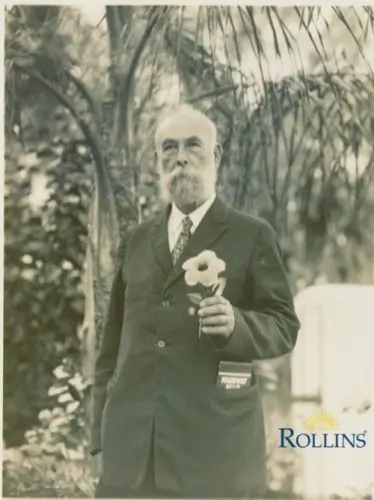
Around here, "Mead Garden" rolls off the tongue as easily as "Park Avenue" or "Lake Eola." It's where we walk the dog, burn off a Saturday morning, and let the kids poke around Howell Creek. But the name on the sign at 1300 South Denning Drive belongs to Theodore Mead, and his life story is wilder, sadder and a whole lot more interesting than most locals know.
Consider the résumé. Butterfly hunter turned citrus grower. Citrus grower turned plant breeder. Plant breeder whose seeds wound up in a landmark scientific experiment.
He spent half a century at Lake Charm in Oviedo, swapped plants with a kindred spirit in Gotha, and lectured at Rollins College. However, he never lived in Winter Park, and the garden with his name on it didn't open until nearly four years after he died.
Table of Contents
A Teenage Butterfly Hunter From New York
Theodore L. Mead (the L stands for Luqueer, in case trivia night ever asks) was born in Fishkill, New York, on February 23rd, 1852. His well-off family backed his curiosity and travels, and a young Theodore Mead was deep into butterflies long before oranges or orchids crossed his mind.
His mentor was William Henry Edwards, one of the country's top butterfly experts. Then the mentorship became a family affair: in 1882, Mead married Edwards's daughter, Edith.
In 1871, at just 19, Mead set off on a sweeping collecting expedition through Colorado. Most of us at 19 were still figuring out laundry. He came home with specimens that helped scientists describe numerous new butterflies, and several were named in his honor. Older accounts linked the trip to the federal Wheeler Survey, but a later dig through his journal and correspondence found no evidence he actually traveled with it.
That butterfly training paid off later. Theodore Mead brought an entomologist's meticulous record-keeping to gardening, logging every cross, every date and every parent plant for decades. Think of him as a one-man database, long before anyone had heard the word.
Florida Started With a Rare Butterfly
Theodore Mead's first Florida trip came in 1869, and yes, it was all about bugs. Near Enterprise, on the north shore of Lake Monroe, he caught an exceptionally rare butterfly that historical accounts identify as Papilio calverleyi.
Florida had another draw, too: a place where subtropical plants could grow outdoors all year. By the early 1880s, around the time he married Edith, he had set up in Eustis on an orange grove his father provided. The plan was sensible: citrus would pay the bills while he chased his botanical experiments.
Life at Lake Charm
In 1886, Theodore Mead bought 85 acres at Lake Charm in Oviedo, right near Edith's aunt Mary and her husband, Dr. Henry Foster, who wintered in the neighborhood.
The couple named their home Wait-A-Bit, a name preserved in a photograph of Edith at the house around 1902 shared on the Rollins College Archives blog. When your hobby involves pollinating a flower and waiting years to see what blooms, "wait a bit" is less a name than a lifestyle.
Lake Charm became his open-air lab. Beside the orange grove, he raised palms from seed and tinkered with orchids, bromeliads, crinums, caladiums, amaryllis and daylilies. Easy way to remember it: Oviedo is where Theodore Mead did the work, and Winter Park is where we remember it.
A Family Story With Real Heartbreak
Not every chapter is sunny. The Meads' only child, Dorothy, died of scarlet fever as a little girl in the early 1890s. Edith died in 1927, and he faced his final years without her.
Biographer Paul Butler, writing through the Rollins Archives, fills in the man behind the plant labels using family photographs and letters kept in Central Florida and at Edith's family home in West Virginia. Butler's Mead was into photography and backed Darwin's theory of evolution, which put him at odds with his evangelical mother. Picture a man living through huge shifts in science, faith, technology and family life, all from a lakeside house in rural Oviedo.
The Freeze That Shook Central Florida
Then came the Great Freeze of 1894-1895, which flattened much of Central Florida's citrus and knocked the local farm economy sideways. Around Oviedo, the freezes of the 1890s devastated citrus, and celery stepped up as the crop that mattered in the years that followed.
Mead's response was peak Mead: run an experiment. Leaning on his engineering background, he tested whether overhead irrigation could protect citrus in freezing weather, running a pumped system over about an acre. The garden credits him with an early description and demonstration of a frost-protection method that stayed in agricultural use. To be fair, he wasn't the lone inventor of modern freeze protection, and "early experimenter and advocate" is the honest label. Still, it puts Theodore Mead right in the middle of how Orlando-area growers fought back.
The Plants That Made Theodore Mead a Name Among Growers
Plenty of people collect plants. Mead made new ones, on purpose, and wrote everything down. Research published by the Bromeliad Society International shows just how meticulous those records were. Here's a sampling of his greatest hits.
- Orchids: Decades of floral matchmaking, starting with his first orchid cross in 1891, backed by detailed notes and photographs.
- Amaryllis: The "Mead strain," known for striped blooms that later starred in the early memorial garden.
- Bromeliads: Some of the earliest American hybrids, with records starting in 1922, just before his 70th birthday. Proof it's never too late for a new hobby.
- Caladiums: Breeding work shared within a network of growers that included Henry Nehrling.
- Crinums and daylilies: More hybridizing as part of his wide-ranging work with flowering plants.
- Palms: Numerous varieties grown from seed, helping bring subtropical plants into cultivation.
An Oviedo Link to Orchid Science
Back then, raising orchids from seed was famously fussy. A scholarly history of orchid propagation names "Mead of Oviedo" as a supplier of seeds used in Lewis Knudson's experiments, which helped show that orchid seeds could germinate without their usual fungal partner.
Some retellings get carried away and credit him with today's inexpensive supermarket orchids. That's a stretch. Many researchers and growers shaped modern propagation, and Knudson's contribution was his own.
Untangling the Bromeliad Record
Theodore Mead's bromeliad work gets less hometown buzz, but it has drawn serious study. Butler combed through Mead's notebooks, photos and letters to sort out who bred some of the earliest hybrids, including evidence tied to some of the first crosses between different bromeliad genera. Call it botanical detective work.
Thirty Years of Letters With Gotha's Henry Nehrling
Every plant lover needs a plant buddy, and Mead's lived on the other side of Orlando. Henry Nehrling ran Palm Cottage Gardens in Gotha, and for nearly 30 years the two traded seeds, plants, observations and advice. Nehrling even named a caladium "Theodore Mead" in his friend's honor, the ultimate plant-person compliment.
Rollins still holds their correspondence, including a summarized transcription spanning 1890 to 1929.
A Boy Scout, a Professor and a Plan
Theodore Mead's ties to Rollins College ran deep. Rollins records place him as a special lecturer in botany as far back as the 1890s.
Another key friendship began through scouting. In the early 1920s, Mead met John "Jack" Connery, a young Scout who became his assistant and protégé and later attended Rollins. As Mead got older, Connery helped tend the plants, and he would go on to play a starring role in saving the collection.
Mead also left his scientific library, personal papers and correspondence to Rollins, which is why historians can still piece his life together today.
Theodore Mead died on May 4th, 1936, at age 84, after a stroke. That left a very real problem: how do you keep a demanding plant collection alive when the one person who understood it is gone?
How Winter Park Ended Up With His Garden
Enter Connery and Edwin Osgood Grover, the Rollins "Professor of Books," which may be the best job title in local history. They first looked at acquiring Theodore Mead's Oviedo property before setting their sights on Winter Park.
Land donations around Howell Creek came together from Walter Rose, James Treat, the Leedys and Mary Bartels, and federal Works Progress Administration support helped turn the land into a public garden. The nonprofit Theodore L. Mead Botanical Garden Inc. organized in 1937, and clearing and building rolled on over the next few years.
The garden opened in January 1940. Sources split on the exact day, with some pointing to January 14th and others to January 15th, so consider that your ammo for the next local history debate.
Opening-day Mead Garden was much more of a horticultural showpiece than the wilder spot many of us know now. Butler describes orchids, palms, cycads, ferns, flowering shrubs, daylilies, caladiums and striped amaryllis, all strung together by creekside paths and little waterfalls.
The City of Winter Park took over in 1953, with a lasting string attached: it had to stay a botanical garden. The decades since have brought money troubles, rough patches and volunteer-powered restoration campaigns, plus an ongoing balancing act between plant collections and the site's natural character.
The Mead Name in Oviedo
Mead's name pops up in Seminole County, too. Mead Manor, a subdivision developed by the Oviedo Land Company, is tied to the 1960s, when the arrival of Florida Technological University, now UCF, promised a wave of faculty and staff in need of homes.
It's a neat bridge between two very different Oviedos: Theodore Mead's world of groves and greenhouses, and the college-town suburb that grew up later. Just don't mistake the neighborhood for a preserved historic estate. The records confirm the name, not the survival of his original home.
Where to Pick Up His Trail
Want to follow his trail without leaving greater Orlando? Start here.
- Lake Charm, Oviedo: The landscape most tied to his home, groves and plant trials.
- Mead Botanical Garden, Winter Park: His main public memorial, at 1300 South Denning Drive.
- Gotha: Home of Nehrling's garden and the other anchor of their 30-year plant exchange.
- Rollins College Archives: His letters, family papers, photographs and scientific library, plus the story of the memorial garden.
- UCF's collections: The RICHES archive holds Oviedo history, and Mead's breeding notebook sits in the Michael A. Spencer Bromeliad Research Collection.
For the full story, grab Paul Butler's book Orchids & Butterflies: The Life & Times of Theodore Mead (2016), which leans heavily on surviving letters and family records.
Ninety Years Later, Still in Bloom
A man who spent his life crossing one plant with another, then waiting years to see what grew, left behind a legacy that also took its time. It started with a teenager chasing butterflies in Colorado, took root in an orange grove at Lake Charm, and outlived him only because a former Boy Scout and a book-loving professor refused to let the plants die with him.
So the next time someone suggests a Mead Garden stroll, you can sprinkle in a little local trivia along the way. Theodore Mead is proof that some of the best things in greater Orlando were planted by people patient enough to wait a bit.
🔥 Love Orlando history like this? Well, there's plenty more where this came from, right here.
Sources:
https://bioone.org/journals/the-journal-of-the-lepidopterists-society/volume-69/issue-1/lepi.69i1.a1/An-Updated-Itinerary-of-Theodore-L-Mead-in-Colorado-in/10.18473/lepi.69i1.a1.full
https://richesmi.cah.ucf.edu/omeka/items/show/5706
https://blogs.rollins.edu/libraryarchives/2016/11/17/theodore-mead-the-man-behind-the-mead-botanical-legacy-garden-in-winter-park/
https://www.clickorlando.com/news/local/2025/03/26/from-citrus-to-celery-how-oviedo-became-a-farming-hub/
https://www.bsi.org/new/wp-content/uploads/2015/01/JBS-625_web_final.pdf
https://escholarship.org/content/qt66z8r5sb/qt66z8r5sb.pdf
https://lib.rollins.edu/olin/oldsite/archives/nehrling.htm
https://winterparkmag.com/2015/09/25/the-unofficial-winter-park-hall-of-fame/
https://www.orangeobserver.com/article/mead-gardens-10-year-rebuild
https://richesmi.cah.ucf.edu/omeka/items/show/5277