
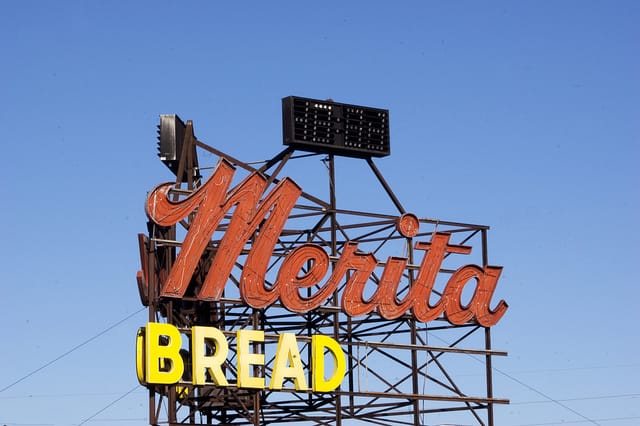
For more than half a century, there was a stretch of Interstate 4 where you didn’t need a GPS to know you were approaching downtown Orlando. You just rolled down your window. The smell of fresh Merita Bread, warm, yeasty, unmistakable, told you everything. The factory at 2200 South Division Avenue sat right along the eastbound lanes, just west of downtown in the Kaley and Orange-Division corridor, and its aroma reached drivers before the skyline did.
For generations of Orlandoans, that scent occupied the same emotional shelf as orange blossoms: proof you were home.
The bakery is gone now, replaced by a truck dealership. But the story of how it opened, what it meant, and why Orlando still can’t let it go says something real about the invisible landmarks, the ones you smell, not see, that stitch a city together.
This is the story of a bread factory, a neon sign, and a smell that an entire city refuses to forget.
Table of Contents
How Merita Bread Came to Orlando
The Orlando Merita Bread plant opened in May 1961 as a modern industrial bakery designed to serve Central Florida and the broader southeastern United States. At the time, Orlando was still years away from the theme-park boom that would reshape the region.
The city’s economy ran on citrus, cattle, and a growing military presence, and a large-scale bakery dropping into the near-south side of town was a significant addition, both as an employer and as a piece of infrastructure feeding the region’s grocery shelves.
The Merita brand itself had deep Southern roots. It traced its origins to the Highland Bakery, founded in Birmingham, Alabama in 1901, which eventually became part of American Bakeries.
Over the decades, the name passed through a series of corporate parents, landing ultimately with Hostess Brands (also known as Interstate Bakeries Corporation). But through all those ownership changes, the name on the building in Orlando never wavered. It always said MERITA Bread, in letters big enough to read from the highway.
Inside, workers turned out sliced breads and buns under the Merita label, and in later years the facility also produced other Hostess bread brands like Wonder Bread and Nature’s Pride.
The plant served double duty: it was both a wholesale baking and distribution hub shipping product across the region, and a retail outlet store where locals could walk in off Division Avenue and buy loaves, rolls, and buns at a discount.
That outlet became a quiet neighborhood institution in its own right, a small perk that made the bakery feel like it belonged to the community, not just the corporation.
The Smell That Defined a Commute
Ask anyone who drove I-4 through the Kaley and Orange-Division corridor between 1961 and 2012, and they’ll tell you about the bread. It wasn’t subtle. On warm days especially, the scent of baking loaves drifted across the highway like a weather system, filling car interiors whether the windows were open or not.
Commuters heading into downtown from the south learned to expect it the way they expected the curve in the road or the exit signs overhead.
Reddit threads and Facebook groups dedicated to Orlando nostalgia still light up whenever someone mentions the Merita Bread smell. People describe cracking their windows on purpose, timing their commute for maximum bread-smell exposure, and associating that stretch of asphalt with comfort in a way that’s hard to explain to anyone who wasn’t there.
Some recall it as the first thing they noticed coming home from college or a long trip, more immediate than any landmark, more personal than any welcome sign.
It was, in the truest sense, an everyday landmark. It didn’t appear on any map, didn’t show up in any tourism brochure, and couldn’t be photographed.
But it existed in the muscle memory of an entire metro area, and its absence, when it finally came, was the kind of loss people struggled to articulate.
Merita Bread and the Workers Who Made It
At its peak during the Hostess era, the Orlando Merita bakery employed roughly 200 to 300 people across production, maintenance, distribution, and retail. These weren’t corporate jobs parachuted in from out of state.
Former employees have described starting at the plant as teenagers and spending entire careers there, working their way through shifts on the baking lines, in the maintenance shops, and on the loading docks that dispatched delivery trucks across Central Florida every morning before dawn.
The factory functioned as a blue-collar anchor on Orlando’s near-south side, the kind of employer that doesn’t get a lot of headlines but holds a neighborhood’s economy together.
For the families who depended on those jobs, the Merita Bread plant wasn’t a landmark or a curiosity. It was a paycheck, a routine, and a source of stability that had been there as long as most of them could remember.
The Hostess Collapse and the Day the Ovens Went Cold
By the 2000s, the Orlando plant was operating under Hostess Brands, and Hostess was in serious trouble. The company had been buckling for years under the weight of mounting debt, legacy pension obligations, and an aging business model that struggled to compete in a grocery landscape increasingly tilted toward fresher and healthier options. A first bankruptcy in 2004 bought some time, but the underlying problems never went away.
In 2012, it all came apart. A nationwide bakers’ strike accelerated the endgame. In November 2012, Hostess asked a federal court for permission to wind down operations and liquidate the company entirely.
The Orlando Merita Bread bakery was shut down as part of that process, abruptly putting nearly all of its roughly 200 local workers out of a job. Across the country, approximately 18,500 Hostess employees lost their positions in what became one of the most high-profile corporate collapses of the year.
For the people inside the Orlando plant, some of whom had worked there for decades, the end came with very little warning. One day the ovens were running. The next, they weren’t. And the smell that had drifted over I-4 every morning since 1961 simply stopped.
Demolition and What Replaced the Merita Bread Factory
After the bankruptcy, Hostess’s bread brands were sold to Flowers Foods, the Thomasville, Georgia–based baking company. But Flowers chose not to reopen the Orlando facility. The building sat empty, its loading docks quiet, its parking lot slowly cracking in the Florida sun.
Eventually, Maudlin International Trucks of Orlando bought the property from Flowers. After several years of vacancy, the company began demolishing the old bakery in August 2015 to build a larger truck dealership on the site. Watching the wrecking equipment chew through the walls of a place that had fed them, literally and economically, stung for a lot of Orlandoans. The building itself was never architecturally remarkable, but its disappearance made the loss feel final in a way that the closure alone hadn’t.
But one piece of the factory survived.
The Neon Sign That Refused to Disappear
The double-sided MERITA Bread neon sign had towered over I-4 for decades, greeting eastbound drivers entering downtown like a glowing welcome mat. It was one of Orlando’s most recognizable pieces of roadside branding, visible long before the downtown exits, a fixed point in the peripheral vision of every regular commuter. When demolition loomed, the question on a lot of people’s minds was simple: what happens to the sign?
The answer turned out to be better than most expected.
In 2014, before the wrecking crews moved in, Maudlin donated the big neon sign and the building’s Merita letters to the Charles Hosmer Morse Museum of American Art in Winter Park. The Morse, already well known for its collection of Louis Comfort Tiffany works, had been quietly building a collection of historic Orlando neon, and the Merita Bread sign was a prize acquisition.
The museum restored it carefully, preserving both sides of the sign and the original lettering. At roughly 18 feet high and 48 feet long, it became one of the largest single objects in the Morse’s entire collection.
Merita Bread Lives On as Public Art
The sign didn’t stay locked away in storage. In recent years, the Morse Museum and the City of Orlando have loaned the restored Merita sign out for public art installations downtown, bringing it back to the streets where it once glowed above the highway. It has appeared during Creative City Project’s IMMERSE festival and as part of Orlando’s 150th-anniversary storytelling initiatives, drawing crowds who remember the original and younger residents discovering it for the first time.
Some of these installations have gone a step further, adding artificial “bread smell” effects around the sign, because the people behind these projects understand that the sign alone only tells half the story.
You have to get the nose involved. The combination of the glowing neon and that familiar yeasty scent has proven to be a remarkably effective trigger for citywide nostalgia, the kind of shared sensory memory that cuts across neighborhoods and generations.
It’s a strange and kind of wonderful afterlife for a piece of industrial signage: held in the permanent collection of a fine-art museum, making guest appearances at festivals, and triggering a wave of sense memory across an entire city every time it lights up.
The Merita Brand Today
Here’s the twist: Merita bread still exists. After Hostess’s liquidation, Flowers Foods acquired the brand along with several other Hostess bread lines. Flowers has since relaunched Merita products in parts of the Southeast, marketing the brand as a longstanding Southern family favorite with roots going back more than a century to that original Birmingham bakery. So the name that once perfumed a stretch of Florida highway is still sitting on grocery shelves, just no longer baked in Orlando.
The factory is a truck dealership. The smell is a memory. But that massive neon sign keeps showing up, glowing the same way it did when it sat above the ovens, reminding a city that some landmarks don’t need walls to survive. For the people who drove that stretch of I-4 and rolled their windows down on purpose, the Merita Bread factory will always be there, not on the map, but somewhere deeper, in the place where smell and memory overlap and refuse to let go.
🔥 Love Orlando history? Well, there's plenty more where this came from, right here.
Sources:
https://www.mapquest.com/us/florida/merita-bread-bakery-345800947
https://en.wikipedia.org/wiki/Merita_Breads
https://www.reddit.com/r/orlando/comments/a2tfaa/i_miss_smelling_fresh_bread_on_i4/
https://www.facebook.com/groups/grewupinorlando/posts/8867778603273279/
https://www.clickorlando.com/news/2012/11/16/orlando-merita-bakery-plant-closes-in-hostess-strike/
https://www.bakingbusiness.com/articles/29192-former-merita-bread-bakery-in-orlando-razed
https://www.wftv.com/news/local/merita-bread-building-orlando-be-demolished/32066581/
https://www.orlandoweekly.com/food-drink/iconic-merita-bread-sign-to-be-removed-2293699/
https://engage.orlando.gov/150-anniversary/stories/merita-bread-sign-a-whiff-of-nostalgia