
Morrison’s Cafeteria had no chef’s table, no craft cocktail menu, and absolutely no opinion about fancy culinary foam.
What it had, for the better part of six decades in Orlando, was a steam-table line long enough to make your arms tired, a tray that got suspiciously heavy somewhere around the fried okra, and an ironclad guarantee that nobody would leave hungry.
From its first Orlando appearance on West Central Avenue in 1932 to its quiet disappearance in the late 1990s, Morrison’s Cafeteria fed churchgoers, shoppers, awkward first dates, and retirees with a formula so beautifully simple it barely qualifies as a business plan: cook a mountain of Southern food, keep it hot, and let people point at what they want.
Table of Contents
A Mobile, Alabama Idea That Couldn’t Sit Still
It all started on September 4, 1920, when a man named J. A. Morrison swung open the doors of the first Morrison’s Cafeteria in Mobile, Alabama, and bet his future on an idea that sounds almost too obvious: let people serve themselves, give them a huge variety of home-style food, and keep the prices low enough that eating out feels like a Tuesday, not a special occasion.
Mobile loved it. Then the rest of Alabama loved it. Then, like kudzu with a business license, Morrison’s spread across the Southeast. By mid-century it was the largest cafeteria chain in the country, roughly 150 locations in 13 states, with the densest clusters in Florida and Georgia.
The secret wasn’t the recipes (though the coconut cream pie had its partisans). It was logistics. A centralized purchasing and distribution system, anchored by a major food-distribution subsidiary in Tampa, set up in 1946, let every Morrison’s in the chain crank out more than 100 menu items daily at modest prices without the roast beef in Daytona tasting noticeably different from the roast beef in Birmingham.
That kind of consistency doesn’t win culinary awards, but it wins repeat customers, which is really the only award a cafeteria needs.
Morrison’s Cafeteria Lands in Orlando: 1932
A 2025 timeline from the Orange County Regional History Center pinpoints the arrival: “Morrison’s Cafeteria announces opening on West Central Ave.” in 1932. This was Depression-era downtown Orlando, a city still figuring out its commercial core, lined with department stores and movie palaces along Orange Avenue and Central Boulevard. Morrison’s walked right in and made itself at home, one more reason to take the bus downtown on a Saturday.
Florida was already in the chain’s crosshairs (there was at least one location in Daytona Beach by 1950), but the Orlando opening planted the flag a full generation earlier.
And the city was, frankly, a cafeteria’s dream: a growing population, a healthy supply of snowbird retirees, and enough churches per square mile to guarantee a post-sermon lunch rush every single Sunday.
Where a WWII Veteran Found Tea, a Cashier, and Eventually a Wife
The original Orlando Morrison’s sat right in the thick of downtown, on West Central Avenue just off Orange Avenue, surrounded by the shops and theaters that made that stretch the beating heart of city life. Like any self-respecting neighborhood institution, it accumulated stories. The best one is a love story.
In 1947, a World War II veteran named Mario Mesa walked into Morrison’s Cafeteria on Central Boulevard with his father. They were just stopping in for a glass of tea.
Behind the register was a young woman named Glenette, who’d moved to Orlando in September 1946 and taken the Morrison’s job, conveniently close to St. James Catholic Cathedral on North Orange Avenue, where she’d go on to serve for decades.
Mario and Glenette started dating. They took walks around Lake Eola after meals. They got married. Their entire courtship began because one guy wanted iced tea and happened to pick the right cafeteria. If that isn’t an argument for eating out more, nothing is.
The Mesas weren’t unusual in treating Morrison’s as a social hub, they were just the couple with the best origin story. For whole swaths of Orlando, the cafeteria was baked into a Saturday routine that went roughly like this: ride the bus downtown, wander the Orange Avenue department stores, catch a matinee if you were feeling extravagant, and then pile into Morrison’s for lunch.
Servicemen, office workers, young couples, retirees stretching out an afternoon, everyone showed up. Morrison’s wasn’t the only restaurant in downtown Orlando, but it was the one where you’d accidentally run into half your neighborhood.
Trays, Steam Tables, and the Dessert-Line Traffic Jam
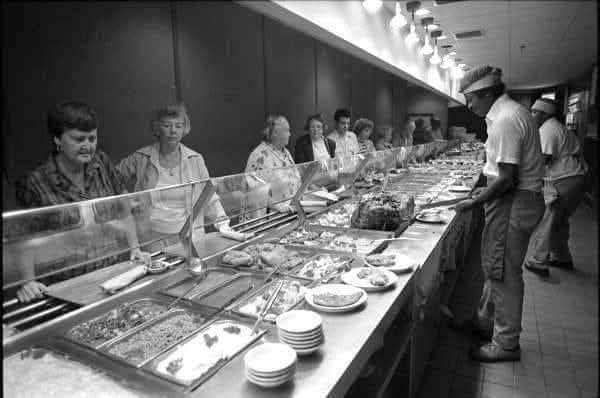
If you never experienced a Morrison’s firsthand, here’s what you missed. You grabbed a plastic tray at the entrance, set it on metal rails, and began a slow, glorious shuffle down the steam-table line, pointing through the glass at whatever caught your eye while uniformed servers scooped portions onto your plate with the calm efficiency of people who had done this ten thousand times.
You'd pick up a tray, slide it down the rails, and point your way through a lineup of ladies who'd pile on whatever you asked for.
And there was a lot to point at. The kitchens turned out over 100 items daily, roast beef, fried chicken, liver and onions, fried fish, turnip greens, fried okra, mac and cheese, and a rotating cast of whatever Southern vegetables were in season.
Then came the desserts, which is where the line always slowed to a crawl: chocolate cream pie, coconut cream pie, strawberry shortcake, and enough cakes to paralyze anyone with even a mild case of indecision. A writer who visited the last surviving Morrison’s in Mobile reported that the food tasted “just like we remembered”, which, for a cafeteria, is essentially a Michelin star.
The whole operation was more polished than you might expect from a place where you bus your own tray. Uniformed staff, orderly service, and a quiet sense of occasion made Morrison’s feel a notch above your average lunch counter.
Respectable enough for the Sunday after-church crowd. Casual enough that nobody side-eyed your kid’s ketchup situation. In a city where meat-and-three culture ran deep, hitting that sweet spot was everything.
Suburbia Called, and Morrison’s Picked Up
After the 1960s, Orlando did what Orlando does: it sprawled. The space program brought jobs, Walt Disney World opened in 1971 and brought everything else, and subdivisions multiplied like rabbits on a sugar high. Morrison’s, which had been planting cafeterias in suburban shopping centers across the South for years, happily followed its customers out of downtown.
In the Orlando metro, that expansion meant a location on State Road 436 in Altamonte Springs, still fondly remembered by longtime residents, and likely a spot near Colonial Plaza along East Colonial Drive, one of the area’s busiest retail strips.
Farther south, at 3831 West Vine Street in Kissimmee, Morrison’s set up shop along the tourist corridor, feeding both locals and the growing wave of theme-park visitors who needed a break from standing in lines that did not, sadly, end with coconut cream pie.
The End of Morrison’s Cafeteria (Enter Piccadilly)
By the 1980s, the cafeteria business was getting squeezed from every direction. Fast-casual chains were popping up like mushrooms after rain, buffet restaurants were undercutting on price, and younger diners, raised on drive-throughs and pizza delivery, weren’t exactly lining up for the steam-table experience their grandparents adored.
Morrison’s parent company had read the room early and diversified, snapping up Ruby Tuesday in 1982 and launching brands like L&N Seafood Grill. The newer concepts outperformed the cafeterias, and the writing was on the wall, right next to the daily specials board.
The finale came in April 1996, when Morrison’s Fresh Cooking sold its remaining 142 cafeterias, all 13 states’ worth, to rival chain Piccadilly Cafeterias for roughly $46 million. By the late 1990s, virtually every Morrison’s location outside Mobile, Alabama had either been rebranded as a Piccadilly or shuttered entirely.
Piccadilly later confirmed it had absorbed the Morrison’s units in both Kissimmee and Orlando, which means the Central Florida cafeterias didn’t exactly vanish, they just swapped name tags and kept scooping.
Why Orlando Still Can’t Stop Talking About Morrison’s Cafeteria
The buildings are gone or wearing new tenants. The steam tables have been cold for a quarter century. And yet Morrison’s Cafeteria keeps bubbling up in Orlando nostalgia threads and Facebook groups with a persistence that would impress a chain restaurant marketing department, if any chain restaurant marketing department were paying attention.
Mention Morrison’s online and you’ll trigger a flood of memories about downtown department stores, Church Street landmarks, and a version of Orlando that moved slower and ate better.
The staying power is partly generational, the people who rode the bus downtown with their grandparents on Saturdays remember Morrison’s the way they remember the perfume counter at the department store and the sticky floors of the movie theater, as fixtures of a world that felt permanent until it wasn’t. But it’s also the stories.
Mario and Glenette Mesa’s 1947 love story, a WWII vet and a cashier, a glass of tea, walks around Lake Eola, a lifetime together, is the kind of thing that gives a restaurant a warmth no amount of Yelp stars can replicate.
Today, the only Morrison’s Cafeteria still dishing out plates is the original in Mobile, Alabama, where the roast beef and coconut cream pie continue to arrive as reliably as the tide.
For Orlando, “going to Morrison’s” has become a memory rather than a plan, shorthand for a slower, more communal kind of city life, built on the deeply underrated pleasure of standing in line with your neighbors and pointing at whatever looked good.
👉 I hope you love reading Orlando history as much as I like writing it. Get more Orlando history love, right here!
Sources:
https://encyclopediaofalabama.org/article/morrisons-cafeterias/
https://www.fundinguniverse.com/company-histories/morrison-restaurants-inc-history/
https://www.thehistorycenter.org/wp-content/uploads/2025/04/Spring-2025_Reflections_lr.pdf
https://en.wikipedia.org/wiki/Morrison%27s_Cafeteria
https://orlandomemory.org/people/wwii-veteran-mario-j-mesa-jr/
https://www.careyhandcolonialfh.com/obituaries/myra-mesa
http://extinctorlando.blogspot.com/p/blog-page.html
https://www.orlandoentertainmentnews.com/?p=26036
https://www.lagniappemobile.com/news/morrison-s-last-location-serving-classic-dishes-memories-in-mobile/article_d095c8fe-331c-11ef-acba-876450ef92db.html
https://www.facebook.com/eatpiccadilly/posts/been-around-since-1944-and-were-here-to-stay-more-locations-coming-this-year-/1352785906885725/