
Orlando High School was never just a building. For six decades, from its first graduating class of 11 students in 1892 to the morning its longtime principal died at his desk in 1952, it was the academic and social engine of a fast-growing Florida city that couldn’t sit still.
The school hopped between four different campuses across downtown Orlando, launched the careers of a future moonwalker and an NFL Hall of Famer, and when it finally closed, it pulled off one last trick: it split in two, giving birth to a pair of high schools that still play each other in rivalry games today.
This is the story of a school that kept outgrowing itself, and a city that could never quite build fast enough to keep up.
Table of Contents
The First Orlando High School Class Graduates on a Second Floor
The year was 1892. Orlando was still a scrappy little citrus town, its unpaved streets lined with oak trees and general stores, and its first high school classes met on the second floor of a wooden frame schoolhouse that doubled as a grammar school. Younger children studied on the ground level while the older students climbed the stairs to their makeshift classrooms above.
Just 11 students walked across a stage for that inaugural graduation, which, let’s be honest, probably didn’t take very long. The building stood on the downtown block where the Truist Plaza, formerly the SunTrust Center, rises today, so the next time you look up at that glass tower, know that Orlando’s very first high schoolers once recited their lessons on the same patch of earth.
A Fire, a New Building, and the Birth of The Echo
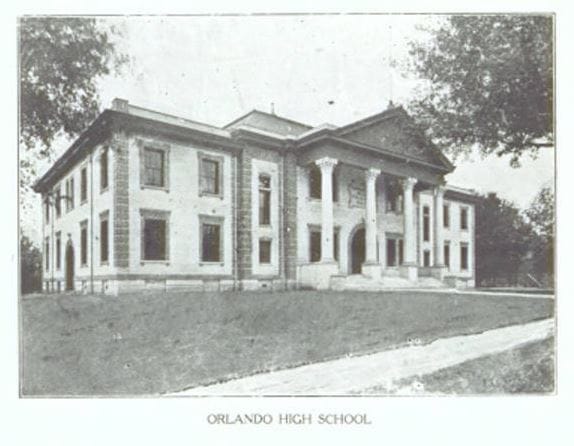
As Orlando’s population climbed in the early 1900s, the frame schoolhouse gave way to a proper brick building at Jackson and Church streets, which opened in 1906 after a fire, because apparently Orlando couldn’t upgrade its schools without a little drama, destroyed the previous structure the year before. The new campus was a genuine step up, with actual classrooms, dedicated space, and room enough to accommodate a student body that kept growing year over year.
It was in this era that student life started to take recognizable shape. In 1912, students created an annual publication they called The Echo, originally a handwritten manuscript read aloud at Christmas programs and “Class Night.”
By 1914, The Echo had become a printed yearbook, distributed to a graduating class of 15, the largest Orlando High School had produced to that point. Fifteen graduates might sound like a slow Tuesday at a modern Orlando school, but in 1914, it was a milestone worth celebrating in ink. The yearbook gave students a sense of permanence, a way to say, “We were here, and it mattered.”
Memorial High School and the Lake Eola Campus
Growth never stopped. In December 1922, students moved into a brand-new building overlooking Lake Eola, officially christened Memorial High School in honor of Orange County’s fallen soldiers from World War I. The dedication was solemn, tying the school’s identity to sacrifice and community memory, and the building itself was gorgeous, situated right on the lakefront where students could see the water from their classroom windows.
But the new name never fully stuck in daily life. Students and yearbook editors, loyal to a fault, stubbornly kept writing “Orlando High School” and “O.H.S.” in their pages, even as the athletic association operated under the Memorial banner. You can rename a school, but good luck renaming the teenagers inside it.
Within about five years, the Lake Eola building was repurposed as a junior high school, a consequence of yet another enrollment surge that demanded yet another campus. That Spanish Colonial Revival structure served the district in various capacities for decades before it was demolished in 1961. If you go looking for it on the lakeshore today, you won’t find so much as a brick.
The 1926 Landmark on Robinson Street
The building that survives today went up in 1926 on Robinson Street near Lake Eola. Architect Howard Montalbert Reynolds Sr., who designed several of Orlando’s most prominent school buildings, went big: a blond-brick façade with six front columns, decorative masonry, and a marble cornerstone that basically dared anyone to call it “just a school.”
Orlando High School finally had a home that matched its ambitions, a building grand enough that the community treated it less like a school and more like something you’d put on a postcard.
Over the following decades, a gymnasium and cafeteria were added, and two stone lion statues were installed to flank the front entrance. Those lions are still there, looking extremely serious about their duties, standing guard over the same doors they’ve watched since the mid-twentieth century. By the late 1940s and early 1950s, enrollment had swelled past 1,200 students, making it the city’s main white high school under the segregated school system of the era.
Yearbooks, Clubs, and a Roster of Famous Alumni
Student life at Orlando High School was rich and varied. Beginning with the class of 1926, the yearbook was renamed Las Memorias, carrying forward the tradition started by The Echo more than a decade earlier. Beyond the yearbook, students filled their schedules with:
- Football, basketball, and other varsity sports
- Debate, spelling bees, and theatrical productions
- An aviation club, rare for any high school at the time, whose members would go on to serve as military pilots in World War II
- Honor societies, student government, and a social calendar lively enough to keep students on campus long after the final bell
The alumni roll call reads like someone made it up. John Young, who walked on the moon during Apollo 16, graduated from Orlando High. Buddy Ebsen, the lanky song-and-dance man who later became a household name as Jed Clampett on The Beverly Hillbillies, got his start here too. Pete Pihos, a two-way end who earned a place in the Pro Football Hall of Fame, played his early ball on these fields. And missionary nurse Mary Evelyn Fredenburg carried the school’s name into a completely different kind of service around the world.
Teachers from the era later recalled a fierce pride in the school and its Robinson Street building, an identity that, as it turned out, would outlast the institution itself.
Segregation and the Parallel Story of Jones High School
Here’s the part of the story that doesn’t get a fun aside. Orlando High School served only white students. Under Orange County’s segregated system, Black students attended Jones High School, founded in 1886 and housed in a substantial red-brick building on North Parramore Avenue starting in 1921. Jones High and Orlando High operated as parallel flagship institutions, academic and athletic centers for their respective communities, separated by law and custom.
That dual system shaped where families lived and which school their children attended. It determined Friday night football loyalties, graduation ceremonies, and career networks for decades. While Orlando High School drew from white neighborhoods closer to the city center, Jones High served Black families across a wider swath of the county, often with fewer resources and older facilities.
The pattern persisted until the long, uneven process of desegregation finally dismantled it, but the years of separation left marks on the city’s geography and culture that are still visible today.
A Principal’s Last Morning and the End of Orlando High
By the early 1950s, the Robinson Street campus was bursting at the seams. The Orange County Board of Public Instruction approved plans for two new high schools, tentatively called North Orlando and South Orlando, to absorb the student body. The last day of classes was set for June 6, 1952.
That morning, William R. Boone, who had served as principal for most of the school’s years in the 1926 building, sat down at his desk and suffered a fatal heart attack. He had guided the school through the Depression, through the war years, through every overcrowded hallway and underfunded semester, earning a reputation as a steady hand who knew every student’s name.
Students and teachers arriving for the final day learned that their school and their principal had reached the end on the same morning. It remains one of the most poignant coincidences in Orlando’s public school history.
Boone and Edgewater: Orlando High School’s Two Heirs
When the new campuses opened that September, the southern school was renamed William R. Boone High School in honor of the late principal. The northern school became Edgewater High School, named for the road that runs through its neighborhood.
Students and faculty from Orlando High were split between the two, like a family dividing the furniture after a move. They carried their academic and athletic traditions into new hallways. Teachers who had spent entire careers at Orlando High unpacked boxes in unfamiliar classrooms and started over, but they brought the culture with them like carry-on luggage.
In a real sense, every Boone Brave and every Edgewater Eagle traces a line straight back to Orlando High School.
Howard Middle School: The Building Lives On
After the high school closed, its 1926 Robinson Street building was converted into Howard Junior High, and today it operates as Howard Middle School Academy of Arts. A plaque honoring William R. Boone hangs near the front doors, a quiet reminder that Orlando High School once called this building home.
The stone lions still stand watch, unbothered by the fact that the school they’re guarding changed its name decades ago. The six columns still frame the entrance. And local preservation groups, along with the Orange County Regional History Center, regularly feature the structure as one of downtown Orlando’s best surviving examples of 1920s school architecture.
Orlando High School occupied four campuses in 60 years, educated more than a generation of the city’s leaders, and when it ended, it didn’t vanish. It split, multiplied, and left its fingerprints on two high schools and one very handsome middle school that still anchors Robinson Street. Most schools get one building and call it a day. This one needed four and still ran out of room.
Walk past those stone lions on any school day and you can practically hear the echo, if you’ll pardon the yearbook reference, of a school that never stopped growing, even after it closed its doors for good. Not bad for a place that started on a second floor.
🔥 Want more Orlando history? Well, there's plenty more where this came from, right here.
Sources:
https://anniversary.ocps.net/stories/orlando_high_school_history
https://stars.library.ucf.edu/cfm-texts/470/
https://www.thehistorycenter.org/back-to-school/
https://www.orlandoarchitecture.org/post/the-architect-of-orlando-s-first-schools
https://en.wikipedia.org/wiki/William_R._Boone_High_School
https://en.wikipedia.org/wiki/Edgewater_High_School
https://usgenwebsites.org/FLOrange/history_of_orlando_hs.html