The Empire Hotel at 32 West Central Boulevard isn't just another red brick box in downtown Orlando. It's a 114-year-old time capsule that has hosted silent film stars, sheltered tailors and lunch counters during the Depression, gone dark and dusty in the 1970s, and most recently pulsed with the bass of one of the city's busiest nightclubs.
Now it's quiet again, and on the market for $12 million. The story of how a single building can wear that many hats says a lot about Orlando itself.
Today the address is officially 28–44 W. Central Blvd., but most longtime locals still know it by the name carved into its century of memory: the Empire Hotel.
Below is the full arc, from the Georgia-born entrepreneur who built it without architectural plans, to the silent film stars who slept under its roof, to the buyers now circling its future.
Table of Contents
The Man Who Built an Empire, James Bailey Magruder
Every great building begins with a stubborn person. In this case, that person was James Bailey Magruder (1859–1925), a Georgia-born businessman who arrived in Orlando and proceeded to plant his flag in nearly every corner of the growing city. He owned the Lucerne Theater, ran multiple commercial ventures, and was a landlord and employer in Jonestown, Orlando's first African American neighborhood, where he developed a workers' subdivision as early as 1890, according to the Orange County Regional History Center.
Magruder originally pitched the building under the working name "The Majestic Hotel." Local lore claims he hired the firm Hoequist & Knight to put it up, and that he did the whole thing without formal architectural plans. Whether that's apocryphal or accurate, the result was solid enough to outlive him by a century.
The Magruder family kept their name on the Empire Hotel well into the 1930s; archived photographs at UCF still bear the label "Empire Hotel, Owned and Operated by C.G. Magruder," suggesting a son or relative took over before the family's mounting tax debts forced their Orlando land holdings to be sold off by 1935.
A Hotel That Was Genuinely Ahead of Its Time (1912–1913)
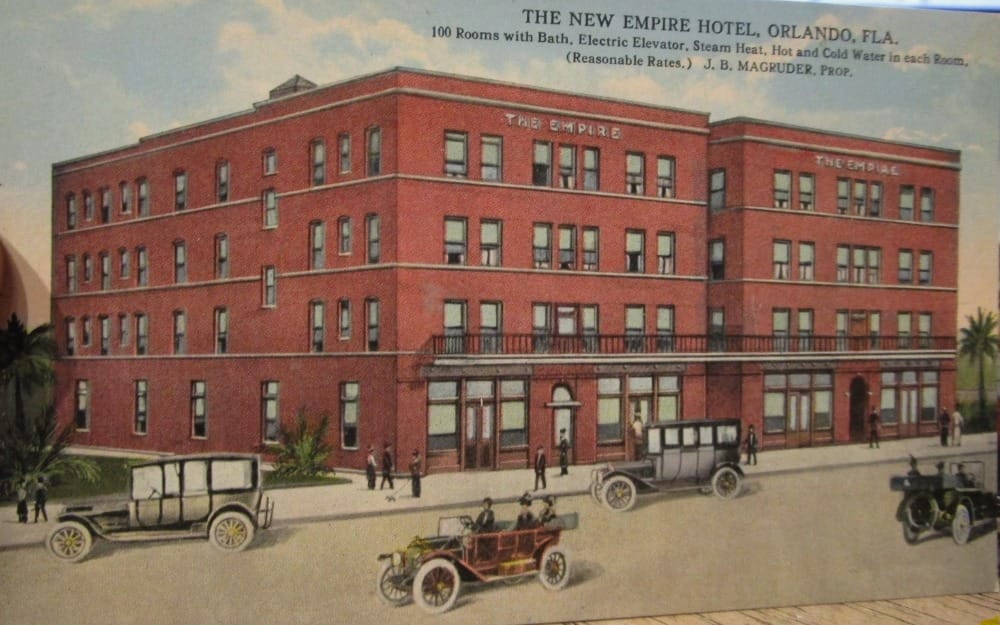
Sources squabble over the exact opening year, some say 1912, some say 1913, but the building was up and running by 1913. The four-story, roughly 38,000-square-foot brick structure rose at the corner of West Central Boulevard with a feature still visible today: a second-floor balcony facing the street, an architectural fingerprint that survived every era that followed.
For the Florida of 1913, the Empire Hotel was almost showing off. It opened with 100 guest rooms, each with hot and cold running water in a private bath, practically unheard of for mid-priced lodging at the time. It was advertised as "Orlando's Most Popular Medium Priced Hotel," and it had two amenities that genuinely turned heads: an electric elevator, prominently featured in its early advertising, and air-conditioning.
According to Haunted Places and other historical accounts, it was Orlando's first and only hotel to offer A/C, a meaningful luxury given the swampy subtropical summers.
When Florida Almost Beat Hollywood, and Stars Slept at the Empire
Here's a fact most Orlandoans don't know: in the early 1900s, Florida was outproducing Hollywood roughly two to one in silent film output. Studios like Kalem and Vim were churning out reels at a furious pace, and Jacksonville was a real rival to Los Angeles for cinematic dominance, a chapter ClickOrlando explored in detail.
In the 1920s, with R.E. Brabel managing the property, the Empire Hotel became a regular landing spot for actors, actresses, and crew members making their way through Central Florida on shoots.
The Fowler, Feeney & Associates law firm, later occupants of the building, preserved that detail in their own corporate history. Picture it: a director sweating through a linen suit, riding a private elevator to an air-conditioned room with hot running water. In 1923, that was practically Hollywood luxury, just dropped into downtown Orlando.
Pete the Tailor, Bob's Place, and the Depression-Era Pivot
By the 1930s, glamour had given way to practicality. The ground floor, the same space that would much later host Ember, had been carved up among small commercial tenants. According to Orlando Retro, the lineup included an auto parts store, a tailoring shop called Pete the Tailor's, and a lunch counter named Bob's Place. Next door, the Mandarin Club operated in what would eventually become Ember's Mediterranean-style open patio.
This kind of mixed-use arrangement, retail at street level, rooms upstairs, was textbook Florida hotel survival strategy through the Depression. Automobiles were pulling tourists toward roadside motels, and downtown hotels everywhere had to find new ways to keep the lights on.
The Empire Hotel adapted, the brick walls just kept absorbing decades, and the upper floors quietly continued operating as guest rooms even as the storefronts below changed hands every few years.
Decline, Vacancy, and a 1984 Comeback
Post-World War II, downtown Orlando suburbanized hard. The Empire Hotel's hospitality identity faded by the 1960s, when the building was reworked into office space and the original guest rooms, once celebrated for private baths and modern amenities, were carved up for tenants. By the 1970s, it was sitting closed and vacant, according to a notation on archived photographs at UCF.
A computer reseller passed through as a tenant in the 1980s, and in 1984 the building got a meaningful renovation that gave it a second adult life as an office and retail complex. Crucially, that 1984 redo preserved the brick facade and the second-floor balcony, meaning the 21st century inherited a building that still looked like 1913 from the sidewalk.
Ember: The Nightclub Chapter (2008–2024)
If you're under 40 and in Orlando, the Empire Hotel probably first registered as the building Ember was in. Ember opened on the ground floor in 2008, the project of Church Street Entertainment partners Dirk Farrow and Doug Taylor, Georgia Tech fraternity brothers profiled by Orlando Magazine who waited five years to lock down the Central Boulevard space.
In 2009 they added a 6,322-square-foot courtyard next door, built where the old Mandarin Club once stood, and turned Ember into a Mediterranean-style indoor/outdoor restaurant-bar pitched at the after-work professional crowd. It was a deliberate departure from the rowdier scene a few blocks away on Church Street, and for more than 15 years it worked.
Then, in December 2024, Orlando Weekly reported that Church Street Entertainment was closing Ember along with four other downtown venues, citing tough market conditions. The lights went out for the first time in over a decade.
The Ghosts Reportedly Never Checked Out
Buildings this old tend to collect stories, and the Empire is no exception. Bartenders and patrons during the Ember era reported unexplained sounds, flickering activity, and ghostly figures in the upper halls, enough chatter to land it on the Haunted Places registry. With more than a century of guests, residents, and late-night employees passing through, the lore writes itself. Whether you buy any of it is up to you, but the building is a reliable stop on local ghost tours.
The $12 Million Question: What Happens Next?
As of early 2025, the Empire Building is for sale at $12 million, reduced from an original $13 million ask when it first hit the market in January 2023, according to the Orlando Business Journal. It's owned by Empire Florida LTD, an entity tied to Orlando attorney James "Skip" Fowler, whose office sits inside the building. Roughly 50% of the four-story, 38,666-square-foot structure is leased to office tenants on the upper floors.
Prospective buyers are reportedly weighing two ideas that would honor the building's bones: turning it back into a hotel, or converting the upper floors into residential apartments while keeping retail on the ground level. A feasibility study by HR&A Advisors floated a plan for 58 multifamily units across the existing building plus a freestanding addition, with total development costs estimated at $19 million.
There's a catch, and it's a good one. The Empire Hotel sits inside a designated Orlando historic district, so any exterior changes need approval from the Historic Preservation Board.
The City of Orlando also offers a 10-year property tax exemption for qualifying rehabilitation projects in historic districts, which could meaningfully shift the math for a developer willing to respect the brick. The building's zoning (AC-3A/T/HP) bakes in that preservation requirement.
Whichever direction the next owner takes, the project will land inside one of Orlando's most-watched preservation conversations. Convert the Empire Hotel into apartments and you give downtown a rare residential building with century-old bones.
Bring it back as a boutique hotel and you complete a poetic loop, guests once again checking into the building Magruder dreamed up before World War I.
Empire Hotel at a Glance
| Detail | Information |
| Address | 28–44 W. Central Blvd., Orlando, FL 32801 |
| Built | 1912–1913 |
| Builder | James Bailey Magruder |
| Original Rooms | 100 guest rooms with private baths |
| Standout Amenity | First air-conditioned hotel in Orlando + electric elevator |
| Building Size | ~37,000–38,666 sq ft, four stories |
| Ember Nightclub Era | 2008–December 2024 |
| Current Status (2025) | Listed for sale at $12 million; ~50% leased |
| Historic Status | Located inside an Orlando historic district |
Why the Empire Hotel Still Matters
Most cities lose their oldest buildings without anyone noticing, they get knocked flat for parking lots or replaced with glass towers that say nothing about anywhere. Orlando, more than most American cities, has a reputation for that kind of erasure. So the fact that a 1913 hotel still stands at one of downtown's busiest corners, still wearing its original brick and balcony, is not a small thing.
The Empire Hotel is one of the very few structures in central Orlando that can credibly claim to have been around before automobiles dominated American streets.
The Empire Hotel has been a luxury inn, a film-industry crash pad, a tailor's shop, an auto parts counter, an empty shell, an office building, a nightclub, and is now waiting to find out what's next. Few American buildings of any age get to live that many lives.
Whoever the next owner turns out to be, they'll be inheriting more than 38,000 square feet of red brick. They'll be inheriting a piece of Orlando that has somehow refused, for 114 years, to disappear.
🔥 Want more Orlando history? Well, there's plenty more where this came from, right here.
Sources:
https://www.thehistorycenter.org/jonestown-boye/
https://www.hauntedplaces.org/item/empire-hotel-building-ember/
https://www.clickorlando.com/podcasts/2024/09/30/floridas-forgotten-film-legacy-how-the-florida-film-industry-was-nearly-bigger-than-hollywood/
http://www.ffalaw.org/empire-building.php
https://orlandoretro.com/2014/01/17/10-historic-places-in-orlando-to-get-a-drink-part-1/
https://www.orlandomagazine.com/spotlights-they-own-the-night/
https://www.orlandoweekly.com/news/five-downtown-orlando-clubs-close-including-ember-chillers-and-irish-shannons-38375564/
https://www.bizjournals.com/orlando/news/2025/01/02/downtown-ember-sale-historic-district.html