
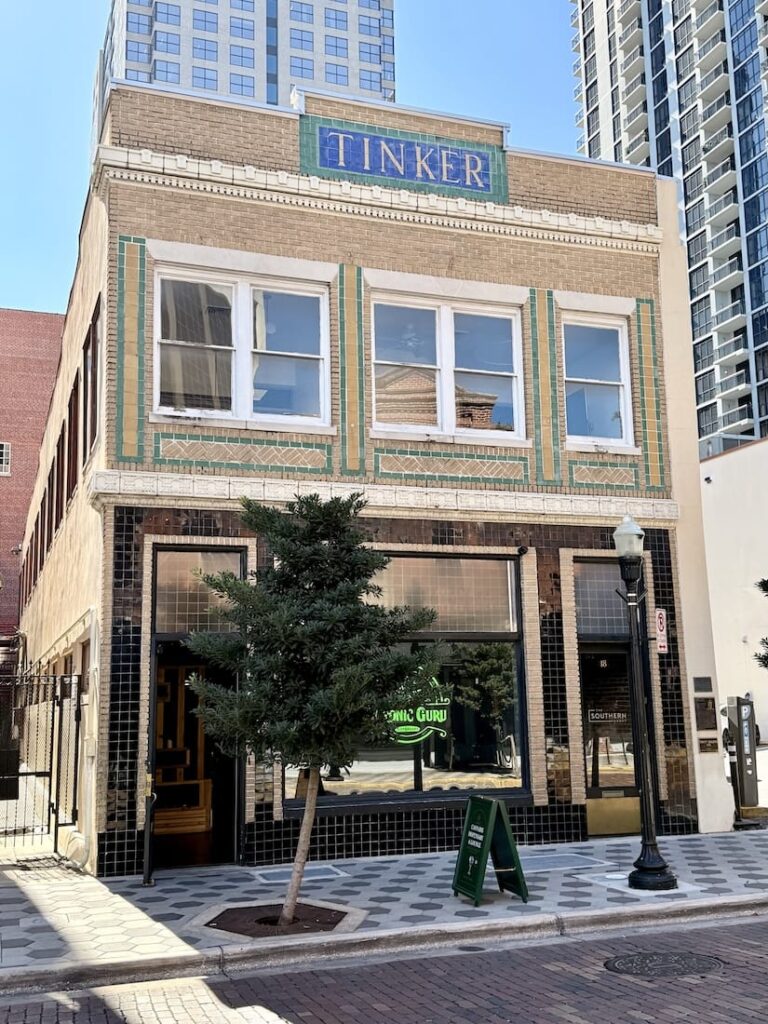
Here's a little experiment for your next stroll through downtown Orlando: stand on West Pine Street, look up past the storefronts, and find the word TINKER spelled out in mustard-colored letters on a field of blue glazed tile, two stories above the sidewalk.
No, it's not a vintage toy shop. And no, it has nothing to do with fixing things, although the man behind the name did spend a good chunk of his life trying to fix the Orlando real-estate market in his favor.
That name belongs to Joseph B. "Joe" Tinker, a Hall of Fame Chicago Cubs shortstop who retired from baseball, moved to Central Florida, got wildly rich during the 1920s land boom, went spectacularly broke, and still managed to leave his name stamped on one of the most charming little buildings in the city.
The Tinker Building at 16–18 West Pine Street has been standing since 1925, and honestly, its story is more entertaining than most Netflix series.
Table of Contents
Joe Tinker: Big-League Ballplayer, Bigger-League Personality
Joe Tinker was born in 1880 and broke into the majors in 1902 as the Cubs' starting shortstop. He quickly became one-third of the most famous double-play combo in baseball history, "Tinker to Evers to Chance," a phrase so catchy that New York newspaper columnist Franklin P. Adams turned it into a poem in 1910 that people are still quoting.
And Tinker could actually play. He wasn't just a meme before memes existed. With Tinker at shortstop, the Cubs claimed National League pennants four times, 1906, 1907, 1908, and 1910, and walked away with the World Series trophy in both 1907 and 1908. He went on to manage the Cincinnati Reds and the Chicago Whales of the Federal League, then worked his way through minor-league front offices.
Then, in 1920, he packed his bags and headed south to Orlando.
At the time, Orlando was basically a citrus town with big dreams and dirt roads. Tinker came to manage the local pro ball club, which fans immediately, and delightfully, christened "Tinker's Tigers." Playing in the Florida State League, the team won the league championship and the Temple Cup in 1921.
The city got so fired up that it built a brand-new regulation-size ballpark that was reportedly larger than the field the New York Yankees played on. For a minor-league team. In Florida. In 1921. That's the kind of energy Joe Tinker generated.
But he wasn't done. Not even close.
The Tinker Building and the 1920s Land Boom
If you've never read about the Florida land boom of the 1920s, buckle up, it was absolutely bananas. People were buying and flipping swampland sight unseen, fortunes materialized out of thin air, and every other person in the state seemed to be founding a real-estate company. Orlando was smack in the middle of the madness, and Joe Tinker cannonballed right in.
He co-founded Tinker-McCracken Realty Company and became one of the city's most prolific developers. His projects had names that sound like they were invented by a Florida Man name generator: Lawson Park, Jamajo, Tinker Heights. He even had a stake in the Seminole Race Course at Longwood.
And in 1925, at the absolute peak of the frenzy, he built his headquarters: a snazzy two-story commercial building at 16–18 West Pine Street, right in the beating heart of downtown.
The H-C Construction Company of Orlando put it up on a narrow lot, about 26 feet wide and 111 feet deep, that had previously held the Giles-Ellis Building, an 1880s commercial structure. It was the kind of building that said, "I used to be famous for turning double plays, and now I'm famous for turning profits."
At least, that was the plan.
Inside the Architecture of the Tinker Building
For a relatively small building on a skinny lot, the Tinker Building punches way above its weight in the looks department. Only the north-facing street façade got the full dress-up treatment, the other sides faced alleys or shared walls, but Tinker clearly wanted anyone walking down Pine Street to stop and stare.
The façade is built of brick and clay-tile masonry, clad in buff brick and cream-colored terra cotta, then absolutely loaded with glazed ceramic tile in blue, green, buff, and black. The entire ground floor is wrapped in black glazed tile. It's like the building got a tuxedo from the waist down and a party shirt from the waist up.
At the roofline, that iconic stepped parapet spells out TINKER in mustard-on-blue tile with a green border, subtle as a neon sign, and twice as memorable.
Below the nameplate, terra cotta belt courses divide the stories with a chain motif of circles and bars on one level and dentils and shield motifs on another. Between the second-story windows, glazed tile panels and herringbone brickwork fill the spandrels.
The ground floor was laid out symmetrically: a big central plate-glass display window with flanking doors, one for the shop, one for the stairs to the second floor. Transoms above the entrances originally held geometric colored glass, though later renovations swapped them out.
The interior? The National Register of Historic Places nomination politely calls it "architecturally undistinguished." (Ouch.) It's been remodeled multiple times over the decades, so the original layout is long gone.
But one lovely detail survives: a ceramic tile floor in the second-floor entrance vestibule, a quiet flex from a man who clearly understood the importance of a good first impression.
A Century of Tenants: From Sewing Machines to Alt-Weeklies
The Tinker Building was always meant to be a money-maker. Tinker used the first floor for his own real-estate offices when it opened in 1925, but he also rented space to other businesses from day one, because why own a building if you can't collect rent on it?
By the late 1920s, the Singer Sewing Machine Company had moved in downstairs. Balfour Hardware set up shop around 1928 and stuck around through roughly 1941. At one point, a pool hall took over part of the building and became a neighborhood institution, locals described it as "always full-house," packed with players young and old, probably arguing about bank shots and baseball.
Then reality arrived. The Florida land boom collapsed in spectacular fashion in the late 1920s, and Tinker, like practically every other speculator in the state, lost nearly everything. In a twist that's both heartbreaking and kind of wonderful, he went back on the road with a vaudeville-style baseball skit alongside his old double-play partner Johnny Evers. (Imagine explaining that career pivot on LinkedIn.) He picked up scouting gigs, coached youth players, and took whatever work he could find around Orlando.
In 1941, Massachusetts Mutual Life Insurance Company bought the Tinker Building. It later passed to Carey Hand, a prominent local figure known for funeral homes and various business interests. Through the mid-20th century, the building kept humming along in steady commercial use, nothing flashy, but never empty.
Fast-forward to more recent history, and the tenant list gets even more interesting. The building housed the offices of Orlando Weekly, the city's scrappy alternative newspaper, and at one point even the Orlando Magic's front office worked out of there. In early 2022, Orlando Weekly's parent company, Euclid Media Group, sold the building to The Southern Group of Florida, a lobbying and public affairs firm that planned to set up their Orlando shop inside.
From baseball offices to sewing machines to pool halls to alt-weeklies to lobbyists, the Tinker Building has basically hosted the entire spectrum of American commerce under one roof.
Why the Tinker Building Earned a Spot on the National Register
On July 17, 1980, the Tinker Building was officially listed on the U.S. National Register of Historic Places (NRHP #80000957). The nomination cited criteria for commerce, community development, and sports, which is a pretty rare triple play for a two-story building on a 26-foot-wide lot. (Joe Tinker would have appreciated that metaphor.)
The case came down to three things: Tinker's fame as a Hall of Fame ballplayer, his outsized role in Orlando's land boom development, and the building itself as a surviving artifact of that wild era.
That same year, Orlando established the Downtown Historic District, covering about eight square blocks of late-19th- and early-20th-century commercial architecture. The Tinker Building sits within that district alongside other individually listed landmarks like the Rogers-Kiene Building and the Old Orlando Railroad Depot.
You can also find the Tinker Building featured in Steve Rajtar's A Guide to Historic Orlando and on the city's downtown historic walking tour, which, if you haven't done it, is honestly a great way to spend an afternoon.
Joe Tinker's Larger Footprint on Orlando
The Pine Street building is just one chapter in Tinker's Orlando story. Thanks largely to his connections and tireless promotion, Major League teams like the Cincinnati Reds and the Washington Senators, who later became the Minnesota Twins, chose Orlando as their spring-training home.
The city's historic Tinker Field, near the old Citrus Bowl, served as the Senators' and Twins' spring base starting in 1935 (with a pause during World War II).
Even after going broke, Tinker never left. He stayed a beloved fixture in Orlando's sports community, showing up at ballgames, working with young players, and remaining part of the city's fabric until his death in 1948. He's buried in Greenwood Cemetery, not far from the downtown he helped build up and, well, accidentally helped crash.
A Small Building That Carries a Very Big Story
Today, the Tinker Building sits surrounded by office towers, parking garages, and all the glass-and-steel trappings of a modern Sun Belt city. The Amway Center and Exploria Stadium have long since taken over as Orlando's sports landmarks. Chain restaurants have replaced the hardware stores. Nobody's playing pool on Pine Street anymore.
But the colored tile is still there. The name is still legible from the sidewalk.
And for anyone willing to pause, tilt their head back, and look past the coffee shop awnings, the Tinker Building is a direct connection to a wilder, weirder, more wonderfully chaotic version of Orlando, one where a retired baseball shortstop could move to a small Southern city, ride a speculative wave to the top, lose it all, and still leave his name stuck to the side of a building in mustard and blue tile, two stories above Pine Street, where it has stayed, stubbornly, cheerfully, for a hundred years.
🔥 Check out lots more deep-dives on Orlando History, right here.
Sources:
https://citydistrictorlando.com/the-tinker-building/
https://nikkivillagomez.wordpress.com/2015/03/14/tinker-building/
https://richesmi.cah.ucf.edu/omeka/items/show/1778
https://www.orlandoweekly.com/news/euclid-media-group-sells-downtown-orlandos-tinker-building-to-southern-group-of-florida-30614957/
https://npgallery.nps.gov/GetAsset/7353b4ec-ae9e-48d0-9ff6-688e5de503a3
https://www.facebook.com/share/p/19R2d5Qn28/