In 1984, if you wanted to watch live country music on national television, you had two real options: Nashville, or a bar on Church Street in downtown Orlando where the house band was called the Cheyenne Stampede and the barbecue was upstairs.
Orlando was a legitimate answer. For eight seasons across the 1980s and early ’90s, cable viewers around the country tuned in every week to a three-story pile of golden oak and stained glass called the Cheyenne Saloon & Opera House.
Garth Brooks played it. So did George Jones, Tammy Wynette and Roy Clark. Most of those viewers had no idea they were watching a working bar in a city everyone assumed was nothing but animatronic pirates and turnpike exits.
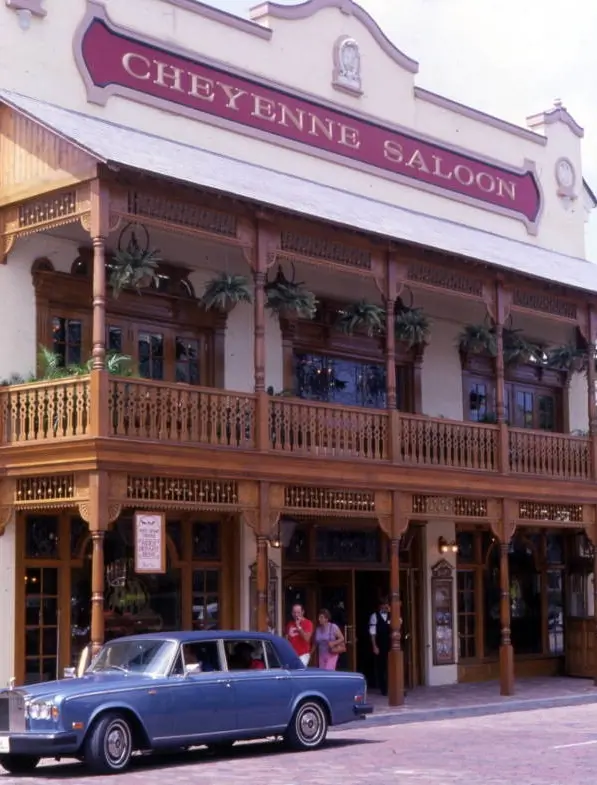
Here’s the part that surprises people who live here: the building never left. It’s still at 128 W. Church St. Same oak. Same chandeliers. Same stairs, and yes, we will get to the stairs.
Table of Contents
It Started With a Saddle Shop
The theme came with the real estate. The Cheyenne went up on the footprint of the Purcell Building, a 1920 structure that had housed Purcell’s, a western wear and saddle store. That corner was selling boots and tack decades before it sold longnecks, which is either excellent planning or a very patient coincidence.
Across the street sat Rosie O’Grady’s Good Time Emporium, the club Bob Snow opened in 1972 as the seed of Church Street Station, a Dixieland-era district built around Orlando’s 1889 railroad depot. By 1980 Snow had ambitions and lumber. The Orlando Sentinel was covering construction that December, back when the project still went by the working title “Cheyenne Saloon & Social Club.” It opened for real on May 28, 1982.
Snow didn’t build a country bar. He built a set. Roughly 250,000 feet of golden oak lumber, reportedly pulled from a century-old Ohio barn, went into three floors of bars, stage and dance floor. Three chandeliers said to have hung in beer baron Joseph Schlitz’s St. Louis home went up overhead. A stained-glass dome crowned a horseshoe-shaped dance floor. Remington-inspired stained glass filled the third story.
Nobody builds like that anymore, largely because nobody wants to sign the invoice.
About that name, by the way: the “Opera House” half was its own bit of theater. Nobody was staging Puccini on Church Street. What the Cheyenne Saloon & Opera House actually delivered was three levels of bars, a stage, a dance floor and a restaurant, wrapped in enough 19th-century detail to sell the story to anyone who walked in.
How the Cheyenne Saloon Ended Up on Cable Every Week
The room became the live-music flagship of Church Street Station almost immediately. The Cheyenne Stampede worked the stage nightly, and while the rest of the complex leaned Dixieland and vaudeville, this floor was straight country and western.
Then Nashville called Orlando. On March 10, 1984, The Nashville Network launched a weekly concert series titled “Church Street Station,” filmed entirely on the Cheyenne Saloon stage with narration by Rex Allen Sr. It ran from 1984 to 1987, came back from 1989 to 1992, and stopped only when TNN moved its music programming to sister network CMT.
Sit with the math for a second: eight years of an Orlando bar going out to living rooms nationwide every week. And because the show was shot in the actual room instead of on a soundstage, the crowd on camera was an Orlando crowd, Central Florida regulars who bought a ticket that night and wound up doing studio-audience duty for the whole country.
The Guest List Is, Frankly, Ridiculous
The names that worked that stage during the show’s run are absurd for a room this size: George Jones, Tammy Wynette, Porter Wagoner, Tanya Tucker, Charley Pride, Roger Miller, Little Jimmy Dickens, Roy Clark, Dottie West, Mel Tillis, Kathy Mattea and Lorrie Morgan.
Then there’s the other list, the one that stings a little. Garth Brooks, Alan Jackson and Travis Tritt all played the Cheyenne Saloon while they were still climbing, years ahead of the arena tours and the greatest-hits packages. Somebody’s parents caught all three for the price of a cover charge and have been insufferable about it ever since.
And none of it was happening in an arena. This was a bar with a horseshoe-shaped dance floor and balconies stacked above it, which meant the crowd was close enough to make eye contact with a future Hall of Famer while holding a beer.
By 1985 the whole operation had hit its high-water mark, moving 1.7 million people through the doors in a single year. Only three attractions in the entire state pulled bigger numbers that year: Walt Disney World, SeaWorld and Busch Gardens. Everything else in Florida was looking up at a bar on Church Street. That is not a cute footnote. For a stretch there, downtown was genuinely in the fight.
Upstairs, the Barbecue
Ask anyone who put real hours into that building and the conversation eventually leaves the stage and climbs a flight of stairs.
The Cheyenne Saloon’s second floor held the Backyard BBQ, listed in period guides as the Cheyenne Saloon Restaurant and billed for Texas-style barbecue. Dinner ran nightly from 5 to 11:30 p.m., full bar. A 1997 nightlife guide called it moderate in cost, open to all ages, casual dress, and rated the barbecue more fanciful than the format suggested, with diners heading back downstairs afterward to line dance it off.
The bar committed to the bit. The house cocktail was the Gunslinger, which arrived wearing a garter that held a miniature holster and a cap gun. Completely ridiculous. You would have ordered one anyway.
What actually stuck with people was the sauce. One longtime regular, a vegetarian no less, called it the best barbecue sauce she had ever tasted and built a weekly ritual around biscuits, coleslaw and a plate of something she technically did not eat. Like the rest of the Cheyenne Saloon, the Backyard BBQ went dark in the 2001 shutdown and again in 2009. It hasn’t served a plate since.
Then the Bottom Fell Out
The trouble started at the top. Bob Snow sold a 50 percent interest in Church Street Station in 1988 and was out entirely by 1989, which kicked off a long run of ownership churn. Worse, Disney and Universal began building their own downtown-style nightlife districts inside the parks. Overnight, the tourists who had been driving into the real downtown had a version with the parking attached.
The Cheyenne Saloon kept swinging. Through the 1990s it ran nightly with a Top 40 country act and a full bar. Orlando Sentinel nightlife listings from 1997 tagged it as an expensive night out for tourists and local country fans, which is a polite way of saying the prices had drifted out of the neighborhood’s reach.
For anyone who had been going since 1982, the slide was slow and then sudden. The rooms stayed open. The bands kept playing. The crowds just kept getting thinner.
As late as 1997, write-ups of Orlando after dark still pointed downtown toward Church Street. The problem was that the answer kept getting older while the competition was brand new and air-conditioned end to end. Most Church Street Station businesses were shut down by 2001. A district that once trailed only the biggest parks in the state went dark inside of 15 years.
Bob Snow’s Encore
Snow came back, because of course he did. In 2007 and 2008 he took an investor stake in the property and reopened the Cheyenne Saloon in 2008, with new neighbors including Bliss Ultra Night Club and Hamburger Mary’s. For a minute, the block looked like it might get a real second act.
It lasted about a year. A dispute with the property’s new owners, stacked on top of lender Tremont Net Funding’s 2008 foreclosure filing, forced the venue closed again in 2009, and the property was foreclosed that same year.
An account from those final months describes Snow paying to fix rotten wood, the roof, the air conditioning and the sound system, patching up a building he no longer controlled while the ownership fight raged around him. Say what you want about the business record. He didn’t walk away quietly.
So What’s In There Now?
Since 2009 the Cheyenne Saloon has worked mainly as a private event and wedding venue, running alongside the neighboring Orchid Garden Ballroom and opening the doors occasionally for live music and one-offs like Orlando Weekly’s Whiskey Business.
Commercial listings peg it at roughly 17,000 square feet of event space at 128 W. Church St., with the original woodwork, stained glass and chandeliers described as relatively untouched since the 1980s. And now, as promised, the stairs.
There is no elevator, so the second and third floors are reachable on foot or not at all. File that under things to know before booking a reception, and under evidence that the place was designed around a 19th-century idea rather than a modern venue checklist.
Practically speaking, a local gets inside the Cheyenne Saloon these days by way of a wedding invitation, a corporate booking, or a special event that opens it up to the public.
Why It Still Counts
Orlando history usually gets told through gates and ticket booths. The Cheyenne Saloon is one of the rare chapters that belongs to the city outright: built here, staffed here, filmed here, and packed for years with people who lived here.
There is an alternate timeline where this building comes down in 2003 and nobody can tell you what used to stand there. It didn’t happen, mostly because the Cheyenne Saloon was overbuilt from day one. The oak and glasswork that made it expensive to construct are the same things that made it worth keeping, and the weddings filling the calendar now are what pay the light bill.
That is an odd kind of survival. Buildings that lose their purpose usually lose their fixtures next, sold off in pieces to whoever shows up with a truck. This one kept its chandeliers.
It’s also a decent rebuttal to the idea that downtown Orlando only recently became somewhere to go after dark. Two generations of locals had a first legal drink, a deeply regrettable line-dancing attempt and a plate of barbecue in that building.
The oak is still up. The glass is still up. And the room where Garth Brooks played before anyone knew the name is still sitting on Church Street, waiting on whoever books it next.
🔥 Love Orlando history like this? Well, there's plenty more where this came from, right here.
Sources:
https://en.wikipedia.org/wiki/Church_Street_Station
https://orlandomemory.org/places/church-street-station-in-the-news-2/
https://iloveorlando.com/articles/church-street-station/
https://www.yourcommunitypaper.com/articles/the-way-we-were-cheyenne-saloon-hits-the-small-screen/
https://orlandomemory.org/places/church-street-station/
https://www.tampabay.com/archive/1997/09/14/orlando-lights-up-as-sun-goes-down/
https://www.orlandoweekly.com/arts/remembering-church-street-station-one-of-floridas-biggest-tourist-attractions-30943532/
https://www.orlandosentinel.com/1997/11/07/nightspots/
http://studiohourglass.blogspot.com/2009/03/so-long-cheyenne.html
https://www.loopnet.com/Listing/128-W-Church-St-Orlando-FL/19075712/