Pop quiz for longtime Orlandoans: what used to sit on that triangular lot where North Orange Avenue points toward Lake Ivanhoe? If you said Kemp's Coliseum, congratulations, you either grew up here or you've heard your parents tell the story, probably more than once.
For nearly 50 years, that patch of Ivanhoe Village was billed as “Central Florida's Playground,” and it earned the title the fun way: with big bands, roller skates, cannonballs off the diving board, bowling pins, and a teenage crowd screaming for The Who.
Today the same stretch is all wine bars, vintage shops, and brunch lines, and most of us cruise past without a clue.
Time to fix that. Here's the full story of Kemp's Coliseum, the building where Orlando learned to dance, swim, skate, and rock.
Table of Contents
A Land-Boom Palace on the Edge of Lake Ivanhoe
The story starts in the giddiest chapter of Florida history: the 1920s land boom, when developers were convinced every acre of the state was about to turn to gold. Riding that wave, the Orlando Coliseum Corporation and builder C.F. Cullen, who was raising sister venues in St. Petersburg and on Davis Island at the very same time, put up the hall that would become Kemp's Coliseum.
It opened its doors on December 23, 1926, at 1640/1700 N. Orange Avenue, with a grand opening worthy of the decade: a multiday blowout featuring vaudeville acts, an elaborate indoor light show, and the Tom Danks Orchestra keeping the floor packed deep into the night. Not bad for a town that was still, at heart, a citrus depot with big ideas.
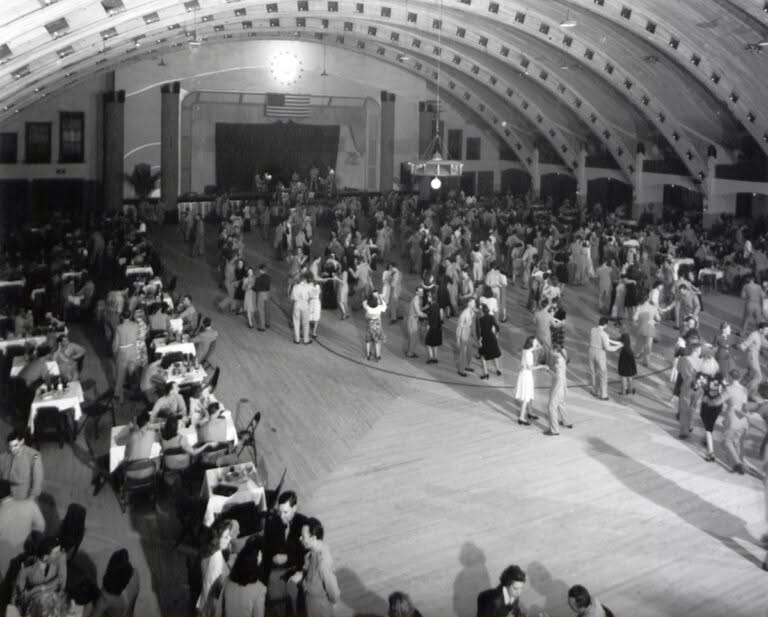
And what a floor it was: solid maple, 114 by 132 feet, laid in a log-cabin pattern that dancers and skaters would polish smooth for the next five decades. Overhead, a 36-foot buttressed ceiling rode on curved trusses with zero interior columns, meaning nobody ever got stuck dancing behind a post. For a 1920s building, that wide-open design was seriously ahead of its time, and it's a big reason the hall could keep reinventing itself, over and over, for half a century.
How the Coliseum Became Kemp's Coliseum
Like plenty of boom-era dreams, the original venture went bust in a hurry. The developers landed in bankruptcy not long after the ribbon was cut, and the big hall sat mostly quiet for a stretch before operator J. Frank Haithcox kept it humming through the 1930s.
Then came 1937, and with it, William R. “Bill” Kemp of Georgia. Kemp bought the property, and from that day forward Orlandoans never really called it anything but Kemp's Coliseum. Here's the detail that makes the whole story sing: Kemp didn't just own the place, he lived in it. He moved his family into a second-floor apartment inside the building, where his daughters and stepson grew up right above the dance floor, falling asleep to big bands and waking up to the smell of floor wax. Bill and his wife, Bessie, stayed in that apartment until their deaths, just one month apart, in 1971.
Let that sink in for a second. For more than three decades, the heartbeat of Orlando's social life had a family sleeping upstairs. Every ticket holder was, in a very real sense, a guest in the Kemps' house.
The Aquaseum, the Bowliseum, and the Best Backyard in College Park
Bill Kemp collected fun the way some people collect stamps. Under his watch, Kemp's Coliseum anchored a growing recreation complex, a homegrown answer to everything a mid-century family could want on a Saturday. And yes, everything got a name ending in “seum.”
First, the Aquaseum. Kemp added locker rooms and a concession stand to the pool property next door and gave the city Orlando's first public swimming pool. Generations of local kids took their first swim lessons there, water ballet classes filled the afternoons, and Edgewater High School's swim team churned out practice laps within earshot of Orange Avenue traffic. For plenty of College Park families, summer simply meant the Aquaseum.
Then came the Bowliseum, a 12-lane bowling alley with a secret weapon that mattered enormously in mid-century Florida: blessed, machine-made cool air. Of everything Kemp built, the Bowliseum is the only structure still standing today, though you'd need to squint to recognize it.
Dancing, skating, swimming, bowling. One family, one stretch of Orange Avenue, and just about every kind of fun the city could dream up.
The Nights Orlando Still Talks About
Before there was a civic center or an arena, Kemp's Coliseum was simply where Orlando gathered. The hall held up to 3,000 people, and over nearly 50 years it seemed like every last one of them found a reason to show up.
Orlando High School played its basketball games on that maple floor. Rollins College fraternities booked it for formal dances. The annual Orlando Fireman's Ball happened there, brass buttons and all, along with Depression-era dance marathons, civic meetings, and political rallies where candidates worked the same room that hosted foxtrots the night before. When television arrived, the building hosted the nationally televised United Cerebral Palsy Telethon. Need something fancier? The venue's Roman Room was the spot to book for private parties.
It's hard to overstate what all of that meant for a growing town. Orlando in those decades wasn't yet the convention-and-theme-park capital it would become. It was a citrus town still figuring itself out, and this one hall doubled as its ballroom, gymnasium, town square, and stage.
And then there was the skating. Ask longtime residents about Kemp's Coliseum and the memories pour out: roller-skating nights gliding along to live organ music, sweet 16 parties, and first dances that turned into first dates that turned into marriages. For generations of Orlandoans, the biggest moments of growing up happened under that 36-foot ceiling.
From Count Basie to The Who: The Concert Years
If the walls of Kemp's Coliseum could talk, they'd recite one of the best setlists in Florida history.
During the swing era, the biggest names in American music made the stop on North Orange Avenue: Louis Armstrong, Tommy Dorsey, Sammy Kaye, Guy Lombardo, Count Basie, and Benny Goodman all played the hall. On those nights, a city of citrus packers and shopkeepers danced to the exact same music as New York and Chicago, no radio required.
When big bands gave way to rock and roll, the bookings kept pace, and the '60s guest list reads like a teenager's daydream. The Beach Boys played there in 1965. Mitch Ryder and the Detroit Wheels roared through in 1966, fresh off “Devil with a Blue Dress On.” The Young Rascals, the Yardbirds, Paul Revere and the Raiders, and Johnny Cash all took the stage.
The Who played the room. Alice Cooper brought his show to Kemp's Coliseum in 1971, and on February 27, 1972, King Crimson performed what turned out to be one of the venue's final concerts.
Read that list one more time. Decades before Orlando had an amphitheater or a modern arena, a dance hall by Lake Ivanhoe was booking acts that now sit in the Rock and Roll Hall of Fame.
Two Weeks Too Late for ELP: The 1972 Fire
The end came fast, and with cruel timing. In 1972, just two weeks before Emerson, Lake and Palmer were scheduled to perform, fire tore through Kemp's Coliseum. The damage was beyond saving, and the building that had anchored Orlando's social life since the Coolidge administration came down for good.
Other venues from the era caught a break. The Beacham Theatre downtown still stands, and the old Municipal Auditorium was repurposed rather than razed. The Coliseum got no such reprieve. It was never rebuilt, and with Bill and Bessie Kemp gone just a year earlier, the whole era ended at once. In the span of about twelve months, Orlando lost both the family and the building that had defined its good times for a generation and a half.
What's Left on North Orange Avenue Today
Here's the part that gets people: almost nothing. No historical marker, no preserved facade, just a few clues hiding in plain sight for anyone who knows where to look. Consider this your treasure map.
The Aquaseum's pool wasn't demolished so much as erased. It's believed to be filled in and buried beneath a parking lot on North Orange Avenue, with some accounts pointing to the lot serving KCG Engineering. Somewhere under the asphalt where commuters park today, the shell of Orlando's first public pool is still down there, holding its breath.
The Bowliseum survives as the complex's lone holdout, now home to Eclectic Interiors and Urban Ashram. Next time you're browsing furniture in Ivanhoe Village, you might be standing right where league night once rolled.
As for the old footprint of Kemp's Coliseum, it sits inside today's Ivanhoe Village Main Street district, an area now known for restaurants, antiques, and craft beverages rather than dance marathons and swing bands. There's a nice bit of symmetry in that. The neighborhood is once again where Orlando goes to have a good time. It just doesn't realize it's following in very old footsteps.
One More Spin Around the Floor
Few addresses anywhere ever packed in this much life: a dance hall, a skating rink, a basketball court, a concert stage, a pool, a bowling alley, and a family home, all under one roof or next door to it, for nearly 50 years. Kemp's Coliseum wasn't just a venue. It was the city's rec room, and half of old Orlando still has a memory parked there.
So the next time you're stopped at a light near Lake Ivanhoe, give that triangular slice of land a second look and picture Kemp's Coliseum in full swing: the maple floor, the organ music, the swim lessons, the big bands, The Who at full volume. Orlando grew up here. All that's left is a parking lot, a repurposed bowling alley, and the stories your parents and grandparents still tell.
Honestly? The stories might be the best part.
🔥 Love Orlando history like this? Well, there's plenty more where this came from, right here.
Sources:
https://www.orlandosentinel.com/2026/04/06/orlando-sentinel-150-monday-memory-of-kemps-coliseum-orlandos-party-place/
https://forgottenrollerrinksofthepast.com/Coliseum%20O%20FL.html
https://ivanhoevillage.org/news/ivanhoe-village-has-history-the-aquaseum-coliseum-boliseum/
https://www.yourcommunitypaper.com/articles/let-the-good-times-roll/
https://www.thehistorycenter.org/places-for-performance/
https://www.pf-db.com/index.php?list=city&choice=Orlando
https://www.setlist.fm/venue/kemps-coliseum-orlando-fl-usa-33d3841d.html
https://orlandoremembered.org/orlando-timeline-1971-1980/