
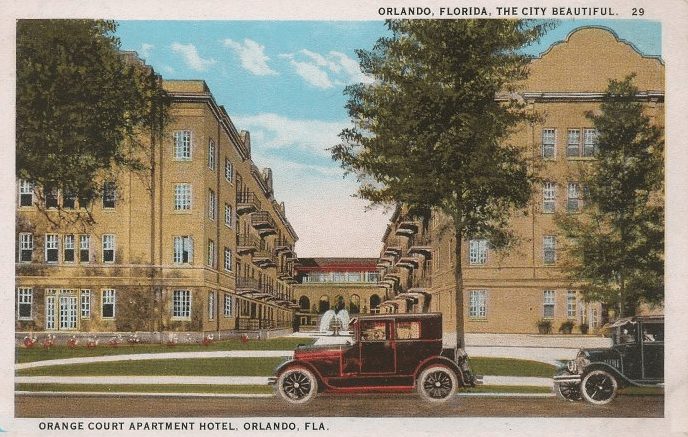
Orlando once had a hotel where you could pick your own breakfast off a tree. Not a marketing line, an actual citrus grove on the property, surrounded by gardens holding more than 500 varieties of tropical plants.
The Orange Court Hotel also had a heated indoor swimming pool, in Florida, which is a bit like installing a snow machine in Buffalo. It stood at Orange Avenue and Colonial Drive for 66 years. Then it was gone.
One piece of it survived, and here is the strange part. The thing that made it out does not carry the hotel’s name.
Table of Contents
A 1924 Flex of the Highest Order
The Orange Court opened in 1924, right at the peak of the Florida land boom, the same money wave that produced the Angebilt and the San Juan downtown. G.A. Miller of Tampa built it. The design came from Atlanta architect G. Lloyd Preacher, who also drew Atlanta City Hall and the Briarcliff Hotel, which should tell you the ambition level involved. Orlando was a small citrus town at the time and somebody decided it needed 275 rooms.
The style was Spanish and Mediterranean Revival, wrapped around a landscaped tropical courtyard. Rooms opened onto private sun balconies draped in jasmine and flame vine. Guests wandered out to the grove and picked oranges. Picture the intersection you now use to get to Mills 50 or Ivanhoe Village, except planted like a botanical garden and staffed well enough to keep it alive.
All of this arrived 47 years before Walt Disney World, which is the part that reliably breaks people’s brains. The Orange Court Hotel was not built to catch theme park overflow, because there was no theme park and no overflow. It went up because Florida real estate was briefly the most exciting thing in America and everybody with capital wanted a piece of the postcard.
The Pool Nobody Needed and Everybody Wanted
The showpiece was Orlando’s first indoor, steam-heated swimming pool. Heating a pool indoors in a state that sells sunshine as its primary export is objectively unnecessary, and that was the point. It was a flex, it worked, and it put the Orange Court on the map.
Inside, wrought-iron chandeliers hung over a lobby that opened into a ballroom, a lounge, and restaurant space. For decades this was the room where Orlando conducted itself. Banquets, receptions, weddings, and an annual citrus industry meeting all rotated through. Celebrities checked in. So did local society, which matters more, because tourist hotels come and go while the places locals pick for their own big nights stick around in the civic memory.
Then in 1944 a hurricane took out WDBO’s studio at the Angebilt, and the radio station just walked down the street and broadcast from the Orange Court until it could go home. Whatever the Orange Court Hotel would later become, for a good stretch it was the closest thing this city had to a living room. For a while the property even belonged to Colonial Hotels, the chain that also owned the Key West Colonial, which you now know as La Concha.
Seven Owners, One Very Bad Sense of Timing
Here is the twist. The place was in trouble almost immediately.
Florida’s land boom collapsed in the mid-1920s, roughly a year or two after the ribbon was cut, and the visitor economy the hotel had been built for simply stopped showing up. Between 1924 and the 1960s, the property changed hands seven times. Around 1960 it went dark completely for about a year before reopening, though some accounts put that closure in 1963.
Seven owners in four decades is not a run of bad luck, it is a business model that quit working before the paint dried. Every new operator inherited the same problem: a 275-room building with resort-level upkeep and a steadily shrinking supply of people willing to pay resort prices downtown. Grand banquets on the ground floor, grim math in the back office. The Orange Court Hotel spent 40 years being genuinely beloved and never once being reliably profitable, a combination Orlando has repeated with half its favorite restaurants since.
How the Orange Court Hotel Became the Orange Court Motor Lodge
In 1964, a Norwegian-born hotelier named A.C. Kavli walked in and bought the whole thing for $500,000 in cash. He kept it until he died in 1985, and he had zero interest in restoring anybody’s glory days.
Kavli’s plan was volume at a low price. Rooms went nightly, weekly, and monthly, priced for people counting dollars rather than stars. So he renamed it the Orange Court Motor Lodge, and the new name was doing real work. A hotel implies a bellhop and a banquet menu. A motor lodge implies a parking space, a clean bed, and a bill you can cover, which was precisely the product. It is also when the building got the one piece of itself that would outlive it: a neon sign packing 115 incandescent bulbs and weighing close to 1,000 pounds, credited to designer Jack Poole and built by Orlando’s own Colonial Art and Neon Company.
For the record, the place answered to several names across 66 years. A 1920s promotional pamphlet advertises the Colonial Orange Court Hotel. Period postcards sell it as the Orange Court Apartment Hotel. A lot of people today go looking for the Orange Court Motel, the one name it never actually had. Understandable, given the motor lodge sign that hung out front through the building’s final decades.
To make the numbers work, Kavli filled in the famous heated pool and carved the old ballroom into more rentable rooms. Read that again. Orlando’s first indoor pool, buried under fill dirt, so the monthly rent could clear. Purists have never forgiven him, though the alternative was probably a demolition permit 20 years sooner. Kavli bought the Orange Court Hotel a second life by refusing to pretend it was still 1925.
By the 1980s the crowd had tilted toward long-term retirees rather than vacationers. People lived there. They got their mail there. Meanwhile a daily shuttle bus still ran out to Walt Disney World for whatever bargain hunters were still booking, making the property one of the strangest hybrids downtown has ever produced: part retirement home, part theme park park-and-ride, inside a Spanish Revival shell built during the Coolidge administration.
The Long Goodbye, Starring a $5.5 Million Price Tag
When Kavli died in 1985, the property hit the market at $5.5 million. The Orange Court Hotel had been gone as a concept for 20 years by then, and what remained was a motor lodge with permanent residents and overnight guests sharing hallways. Nobody bought it. Nobody organized the preservation push that everyone kept agreeing somebody really ought to organize. Four years went by like that, with the asking price hanging in the air and the roof getting older.
In November 1989 the remaining tenants were evicted. By then the building had joined the San Juan and the Lamar in a category one local historian summed up as a decrepit relic, which is what happens to beautiful buildings once nobody can afford to be sentimental about them.
The wrecking crew arrived in 1990, ending a 66-year run at Orange and Colonial. The lot then sat there doing nothing at all, for the tax base or for anybody’s eyeballs, until it finally sold in 1997 for $2.38 million. The Orange Court Hotel survived a land boom collapse, the Depression, a hurricane, and seven owners, and then lost to arithmetic.
What’s Left of the Orange Court Hotel
The Camden Orange Court Apartments occupy the site now and kept part of the old name, which is a nicer gesture than most developers bother with. A large mural of the Orange Court Hotel is painted on the side of the complex’s parking garage, so it is technically still standing on its own corner, in outline form. The place also shows up in a downtown Orlando mural and on a steady stream of vintage postcards that turn up on eBay for a few dollars, usually depicting the courtyard in colors no courtyard has ever been.
One piece of the place got out alive. When the Motor Lodge went dark in 1990, Hugh F. McKean, the first director of the Charles Hosmer Morse Museum of American Art in Winter Park, decided that half a ton of Orlando neon was worth rescuing, and he reached the sign before the scrappers did. It has been part of the Morse’s neon collection ever since, which means a budget lodge marquee now shares an address with world-class Tiffany glass. Somewhere, Kavli is delighted.
And here is the wrinkle worth sitting with. The sign reads Orange Court Motor Lodge, not Orange Court Hotel. The 275-room resort with the citrus grove and the heated pool left behind nothing you can touch. The thrifty second act that filled in that pool left a half-ton marquee that now hangs in a fine art museum. History keeps what it keeps, and it rarely asks which version you were proudest of.
In April 2024 the museum finally lit it in public for a free one-night Neon Night event, the first time in more than three decades that anybody outside the building saw all 115 bulbs going at once. Curious crowds filed into the back lot at sunset to watch a motor lodge sign get switched on. In a metro where most residents arrived long after the wrecking ball, that is a strange and rather lovely way to spend a Friday.
Nobody Killed the Orange Court Hotel. The Math Did.
Orlando loves to tell its own story starting in 1971. It should stop. The Orange Court Hotel is the rebuttal, currently living as a mural on a parking garage: a 275-room resort with a heated indoor pool and a private orange grove, running downtown for nearly half a century before the theme parks showed up, and demolished before most of today’s residents ever got here.
It is also a tidy case study in how a downtown misplaces things. The Orange Court Hotel did not fall to a villain, or to a developer with a grudge, or to a single bad vote at city hall. It was priced at $5.5 million in a market that would not pay it, left to rot while everybody waited on a rescue that never got past the conversation stage, and finally cleared for a lot that then sat empty for seven more years. The San Juan and the Lamar went out the same door. Worth remembering the next time a good old building downtown starts collecting plywood and promises.
The sign is a 15-minute drive from where the hotel stood. Go stand in front of 1,000 pounds of salvaged neon and try to argue that Orlando has no history. It does. Some of it just smells like orange blossoms, weighs half a ton, and lives in a museum on Park Avenue now.
🔥 Love Orlando history like this? Well, there's plenty more where this came from, right here.
Sources:
https://www.facebook.com/groups/HistoricFloridaX/posts/1955996424724038/
https://en.wikipedia.org/wiki/Orange_Court_Hotel
https://orlandoretro.com/2015/03/24/orange-court-hotel-and-orlandos-first-indoor-swimming-pool/
https://morsemuseum.org/programs-events/neon-night/
https://www.wftv.com/news/local/historic-downtown-orlando-sign-be-illuminated-public-1st-time-decades/CDLOBO33TJCRFEIXY5AVHYGRE4/
https://www.orlandosentinel.com/1999/12/26/downtown-landmarks-fade-away/
https://www.orlandosentinel.com/1990/06/10/a-farewell-to-the-orange-court/
https://www.ebay.com/itm/265728877243
https://bungalower.com/2024/03/25/morse-museum-hosting-one-night-only-exhibition-from-its-neon-sign-collection/
https://bungalower.com/2025/02/11/list-10-iconic-orlando-buildings-that-dont-exist-anymore/