
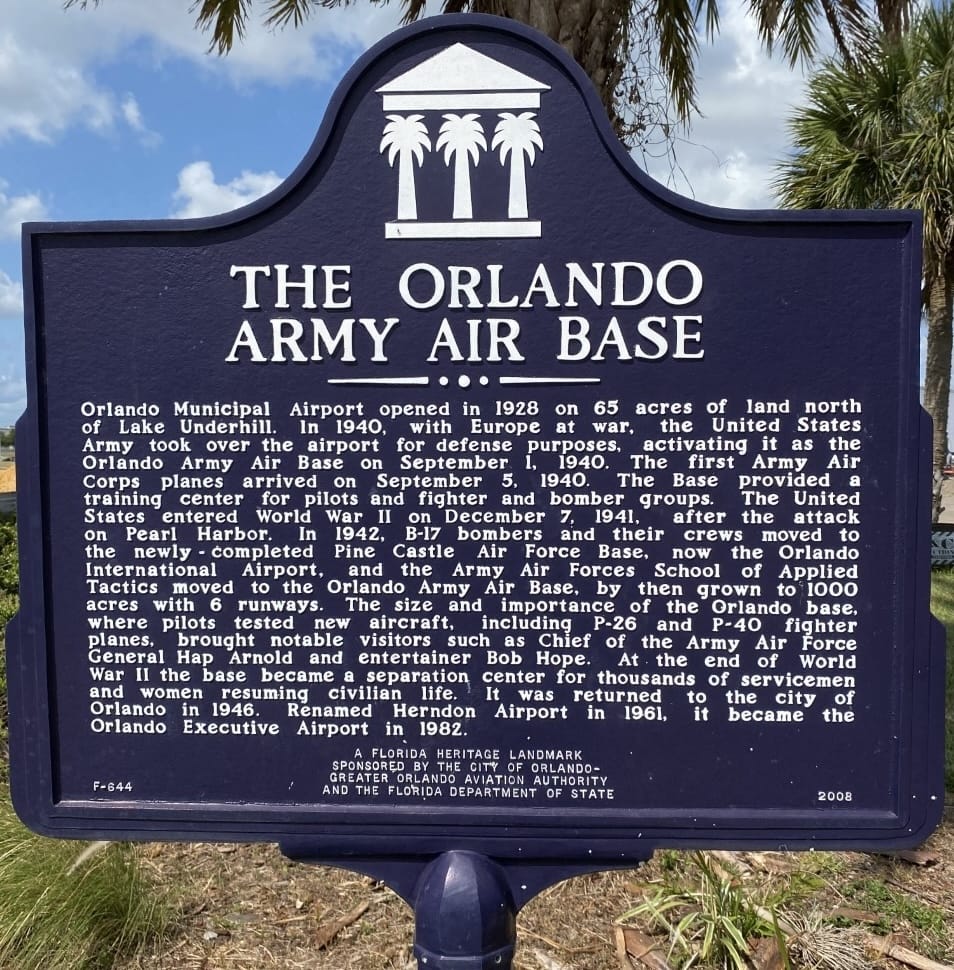
Drive past Maguire Boulevard on your way into downtown Orlando and you'll breeze right by one of Florida's most consequential wartime sites without a clue. The Orlando Army Air Force Base once sprawled across more than a thousand acres of what is now Baldwin Park, Audubon Park, and Orlando Executive Airport. B-17 crews drilled here. Night-fighter pilots learned their trade in Douglas P-70 Havocs. Bob Hope cracked jokes for homesick GIs just a few blocks from where you probably grabbed coffee this morning.
The base's arc is almost too wild to believe. It started as a 65-acre municipal airfield beside a quiet lake. It became the brain trust of American air tactics during World War II. It processed prisoners, then soldiers heading home, then Navy recruits. And when the bulldozers finally rolled in back in 2001, its rubble got buried right under the streets where families walk their dogs today. Buckle up, this one's good.
Table of Contents
Before the War: A Municipal Airport on Lake Underhill
Back in 1928, Orlando opened a modest commercial airfield on 65 acres just north of Lake Underhill. Airmail service kicked off the following year, stitching the young city into the country's growing aviation network. According to Orlando Memory's historical archive, that early civilian infrastructure is precisely what made the site such a catch once the War Department came shopping.
By the late 1930s, Europe was on fire and Washington was getting ready. The Army needed airfields in a hurry, and Orlando happened to have one sitting there, runways and all.
September 1, 1940: The Army Arrives
The Army took formal control of the municipal airport on September 1, 1940, activating the site officially as the Orlando Army Air Force Base. The first planes touched down just four days later, on September 5. The historical marker on Maguire Boulevard, which stands there today as a Florida Heritage Landmark, records the handoff in spare, matter-of-fact language. It doesn't begin to capture what happened next.
What followed was anything but spare. The little airfield ballooned into a hub for bomber and fighter units running coastal patrols under I Bomber Command and the Army Air Forces Antisubmarine Command. German U-boats were sinking tankers off Florida's coast, sometimes in full view of Miami's hotel windows. Orlando's pilots helped push them back.
After Pearl Harbor, expansion shifted into overdrive. The base grew to roughly 1,000 acres with six runways, a scale that's honestly tough to picture now, when the same footprint holds supermarkets, apartment complexes, and the landscaped lanes of Baldwin Park.
The School That Taught America How to Actually Fight in the Air
By 1942, the Orlando Army Air Force Base was pivoting hard. The B-17 bombers stationed there packed up and moved south to the brand-new Pinecastle Army Air Field, the installation that would eventually grow into Orlando International Airport (MCO). That move cleared the way for something unusual, a school.
That fall, in November 1942, Orlando got handed one of the most important assignments of the war, serving as headquarters for the Army Air Forces School of Applied Tactics (AAFSAT). The problem it was built to solve was massive. The Army had exploded from 15 air groups to 67 in a matter of months, but a lot of those units existed mostly on paper. AAFSAT's job was to turn rosters into real combat outfits, fast.
The curriculum ran two weeks of classroom work in Orlando followed by two weeks of field exercises scattered across eleven satellite airfields across Florida. Students rotated through everything from primitive forward airstrips to fully developed bomber bases, simulating the wild range of conditions they'd face in the Pacific or over Germany.
Reorganized as the Army Air Forces Tactical Center in October 1943, the program had trained roughly 54,000 personnel by September 1945 and helped stand up 44 bombardment groups. That's a staggering output for a single command, and it happened in a Florida citrus town most people, if they thought of it at all, associated with oranges.
An 8,000-Square-Mile War Theater
To run tactics at that scale, the Tactical Center claimed something genuinely extraordinary, an 8,000-square-mile training area stretching across north-central Florida, from Tampa to Titusville and from Starke down to Apalachicola. Inside it, mock air campaigns played out against mock enemies on a scale bordering on absurd.
Supporting sites included a bombing range at Ocala Army Air Field, a service center at Leesburg, and a depot at Pinecastle. The Museum of Florida History's entry on Orlando Army Airfield notes that this constellation of installations made Florida one of the most heavily used training landscapes of the entire war.
Aircraft on hand for training and testing included the P-26 Peashooter, the P-40 Warhawk, and the night-fighter Douglas P-70. The 50th Fighter Group used Orlando as its schoolhouse. And the visitors weren't all junior officers, either. General Henry "Hap" Arnold, the chief of the Army Air Forces himself, dropped in, and so did Bob Hope on one of his famous USO swings through the base.
German POWs in the Orange Groves
In November 1944, the war showed up at the Orlando Army Air Force Base in an unexpected form. German prisoners of war started arriving on post, as many as 756 of them, according to base records. They worked on-site as support labor and got contracted out to local orange groves, packing houses, and even a cement plant.
Florida leaned heavily on POW labor during the war, plugging gaps left by men who had shipped overseas. Orlando was part of that pattern, and honestly, it's surreal to picture uniformed Wehrmacht captives hauling citrus crates just a few miles from where B-29 crews were polishing off their final training.
After V-J Day: A Separation Center, Then a New Chapter
When Japan surrendered, the base pivoted almost overnight. It became a separation center, processing thousands of servicemen and women out of uniform and back into civilian life. In 1946, the airfield portion of the Orlando Army Air Force Base south of Colonial Drive was handed back to the City of Orlando. The land got a second life as a municipal airport, picked up the name Herndon Airport in 1961 to honor an early local pilot, and eventually became Orlando Executive Airport (ORL) in 1982, the name it still carries today.
But the story north of Colonial Drive? That one was just getting started.
Orlando Air Force Base and the Return of the Flying Tigers
The northern cantonment, meaning the barracks, headquarters, and support buildings, stayed federal. When the U.S. Air Force split off from the Army in 1947, the site was redesignated Orlando Air Force Base. Almost immediately, it landed a marquee tenant, the reactivated 14th Air Force, successor to Claire Chennault's legendary Flying Tigers of China-Burma-India fame. Orlando, just like that, was a major command hub again.
Over the next two decades, the base hosted units under Air Training Command, Tactical Air Command, and the Military Air Transport and Rescue Services, plus the 4504th Missile Training Wing. At its peak it covered more than 1,100 acres, with lakes, a full hospital complex, and all the trappings of a proper Cold War installation.
Naval Training Center Orlando: The Navy's Third-Largest Campus
A 1966 Pentagon decision flipped the base's service branch entirely. Orlando Air Force Base was inactivated on December 31, 1967, and transferred to the Navy the very next day. Naval Training Center Orlando opened its doors on July 1, 1968, and it didn't stay small for long. Within a few years it had become the Navy's third-largest training campus, running Recruit Training Command, Service School Command, and the Nuclear Power School all under one roof.
Orlando earned a particular footnote in military history in 1973, when it became the sole recruit training site for enlisted Navy women, creating the Navy's first fully co-ed boot camp. Through the 1970s, 1980s, and 1990s, tens of thousands of recruits and nuclear-power trainees cycled through every year.
BRAC, Baldwin Park, and Buried Rubble
The 1993 Base Realignment and Closure round ordered NTC Orlando shuttered. The last recruit company graduated in 1994. The Nuclear Power School closed its doors in 1998. In 1999, the City of Orlando acquired the land and handed it over to a private developer. By 2001, more than 250 buildings had been demolished.
What followed was one of the largest urban infill projects in Florida history. The site of the old Orlando Army Air Force Base was redeveloped as Baldwin Park, a New Urbanist neighborhood whose street grid, parks, and architecture were designed to echo the base that came before. Ceremonial spaces got preserved. Street names nod to Army, Air Force, and Navy units. Blue Jacket Park sits right on the old NTC drill fields.
The wildest detail, though, documented by Abandoned Florida's photo essay on the NNPTC barracks, is that rubble from the demolished base wasn't trucked away somewhere. It was crushed and reused beneath the new parks and streets to improve drainage into Lake Baldwin. The old installation is literally inside the ground that residents walk on every single day.
Walking the Ghost of the Orlando Army Air Force Base Today
Want to see what's left of it? You can stand in three places in a single afternoon.
- Orlando Executive Airport (ORL) preserves the original WWII airfield. Watch a corporate jet lift off and you're watching it roll down runways first laid for P-40 Warhawks.
- Baldwin Park sits right on top of the old cantonment. The History Center's account of Baldwin Park's transformation is hands-down the best single narrative of how the neighborhood was designed to remember.
- The Florida Heritage Landmark marker on Maguire Boulevard, near East Livingston, is the on-site summary. It's small, easy to miss, and almost unreasonably packed with history.
Orlando International Airport (MCO), meanwhile, traces its lineage back to Pinecastle Army Air Field, the 1942 B-17 base that relieved the original Orlando airfield so it could become a tactics school. Every single time a tourist lands for Disney, they're touching the same WWII system.
A Base Hidden in Plain Sight
The old base doesn't show up on postcards. There's no reconstructed hangar, no air-show weekend, no museum gift shop hawking P-40 patches. What there is, instead, is a neighborhood, an airport, a pair of parks, and a roadside marker, all of them sitting on ground that trained tens of thousands of airmen, housed enemy prisoners, launched antisubmarine patrols, and eventually sent a whole generation of Navy recruits into their very first salute.
That's a ton of history for a city better known for theme parks. And it's worth remembering, next time you're cruising down Colonial Drive, that almost everything on either side of you was once, not so long ago, part of the Orlando Army Air Force Base, a runway, a barracks, or a classroom where some young lieutenant was learning how to stay alive.
🔥 Want more Orlando history? Well, there's plenty more where this came from, right here.
Sources:
https://orlandomemory.org/places/orlando-army-air-base/
https://www.hmdb.org/m.asp?m=54047
https://en.wikipedia.org/wiki/Army_Air_Forces_Tactical_Center
https://museumoffloridahistory.com/explore/exhibits/permanent-exhibits/world-war-ii/historical-sites/central-listing/orlando-army-airfield/
https://www.armyaircorpsmuseum.org/wwii_14th_Air_Force.cfm
https://en.wikipedia.org/wiki/Baldwin_Park,_Florida
https://abandonedfl.com/nnptc-baldwin-park-barracks/
https://www.thehistorycenter.org/baldwin-park-in-orlando/