
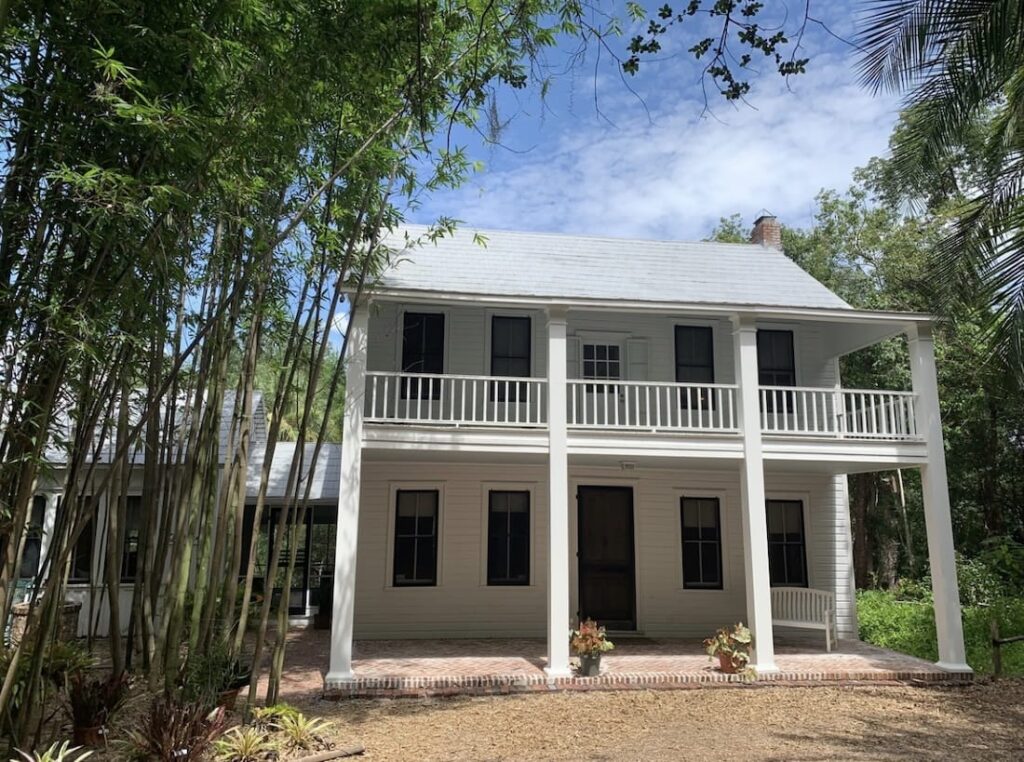
Tucked behind live oaks and towering bamboo on a quiet street in Gotha, Florida, a tiny community just west of Orlando, sits a two-story wooden house that most people drive right past. There is no flashy sign. No gift shop. No parking garage.
Yet Palm Cottage and the six acres of garden surrounding it hold one of the most underappreciated stories in the entire state. This is the place where a single, obsessive naturalist tested more than 3,000 plant species and helped define what a Florida yard could look like, and it all started with an ox-cart, a sawed-apart house, and a whole lot of ambition.
Table of Contents
The Man Who Built Palm Cottage Gardens from Scratch
Henry Nehrling was not your typical Florida settler. Born in Wisconsin in 1853, he spent decades working as a naturalist and ornithologist at the Milwaukee Public Museum, publishing respected volumes on North American birds and plants long before he ever thought about moving south.
But in 1885, he bought roughly 40 acres in the freshly established German-American colony of Gotha, drawn by the vision of a printer-turned-investor named Henry Hempel, who had used wealth from a typesetting invention to lure settlers to Orange County.
Nehrling’s first years at Gotha were seasonal. He traveled down from Wisconsin to clear land, test plantings, and dream big. By the early 1900s, he had assembled about 65 acres and christened the property “Palm Cottage Gardens.”
The name came before the cottage itself, an important detail that says everything about where his priorities lay. The gardens were the point. The house was an afterthought.
A House That Traveled by Ox-Cart
Around 1902, when Nehrling finally decided to relocate his family to Gotha permanently, he needed a proper residence. Rather than build from scratch, he bought a late-1880s frame vernacular cottage about a mile away near Lake Olivia. Workers cut the house into sections, loaded them onto ox-carts or log rollers, and dragged the whole thing to the garden property. It was then reassembled on the site with its semi-detached kitchen wing intact.
The design of Palm Cottage, with its raised floor, deep eaves, and generous cross-ventilation, made it both practical for Florida’s brutal summers and surprisingly easy to take apart and put back together. Once re-erected among the plantings, the house became Nehrling’s residence, his office, and a reception point for a growing parade of visitors. The Orlando Architecture Foundation notes that it remains one of the oldest surviving homes in Orange County.
Palm Cottage as Florida’s Open-Air Laboratory
What Nehrling did with the land around his relocated house went far beyond hobby gardening. In cooperation with the U.S. Department of Agriculture’s Office of Foreign Seed and Plant Introduction, he turned Palm Cottage Gardens into one of Florida’s first horticultural experimental stations.
He wasn’t just planting pretty things; he was running trials. Could this species of caladium survive a cold snap? Would that variety of amaryllis bloom reliably in Central Florida’s sandy soil? How would bamboo from Asia perform alongside native magnolias?
Over the years, Nehrling tested upward of 3,000 species and varieties of tropical and subtropical plants on the property. Roughly 300 of those introductions became foundational to the ornamental horticulture industry across the state.
According to the National Park Service’s nomination documentation, the list includes caladiums, amaryllis, bamboos, palms, crinum lilies, Indian hawthorn, and bromeliads, plants so common in Florida today that most residents assume they have always been here.
They haven’t. Many of them arrived because one man in Gotha was methodical enough to track what survived and generous enough to share what worked.
Palm Cottage Gardens quickly attracted tourists, newly arrived settlers hunting for landscaping ideas, and prominent botanists from around the country. The site became a legitimate destination, an oddity in a part of the state that was otherwise still very much frontier.
When the Cold Came Calling
Florida’s occasional freezes were the great equalizer, and Nehrling was not spared. Severe cold snaps periodically wiped out portions of his collection.
The worst came in 1917, a freeze so devastating that it pushed him to establish a second garden farther south in Naples, a site called Tropical Gardens and Arboretum that eventually evolved into what is now known as the Naples Zoo and Caribbean Gardens. Even after creating that southern outpost, Nehrling kept working the Gotha property until his death in 1929, balancing two gardens separated by roughly 200 miles of Florida backroad.
Bromeliads, Bamboo, and a Second Life for Palm Cottage
After Nehrling died, the Gotha garden fell quiet for several years.
Then, in 1934, Julian and Maggie Nally purchased the property and breathed new commercial life into it. Operating under the name Nally Bromeliad and Bamboo Plantation, they built greenhouses and focused on bromeliads, bamboo, gloriosa lilies, and orchids.
The Nallys extended the site’s horticultural legacy well into the mid-twentieth century, though their additions inevitably altered parts of Nehrling’s original layout.
The Nally operation ran until both Julian and Maggie passed away in 1977. Without stewards, the property was once again exposed to the twin threats that haunt every historic site in Central Florida: neglect and development pressure.
Bulldozers at the Gate: How Palm Cottage Nearly Disappeared
Developers moved in after the Nally era and carved the former 65-acre estate into residential lots. What survived was a roughly six-acre core centered on Palm Cottage and the densest remaining cluster of mature specimen trees.
In 1981, Barbara and Howard Bochiardy bought that remnant parcel. They stabilized the aging house, restored portions of the garden, and added a garage and workshop wing designed to match the original architecture.
But Howard died in 1990, and maintaining a six-acre historic garden as a private owner proved overwhelming. By the late 1990s, the property was showing serious signs of deterioration. Overgrowth was swallowing the specimen trees. The house needed attention. The clock was ticking.
In 1999, a group of local advocates formed the Henry Nehrling Society, a nonprofit with one clear mission: save the place.
Their push worked. The State Division of Historical Resources recognized Palm Cottage Gardens as a site of statewide significance in early 2000, and on November 7 of that year, it was officially added to the National Register of Historic Places. The Cultural Landscape Foundation later spotlighted the site as a threatened historic landscape, amplifying the call for preservation funding and public attention.
Restoring Palm Cottage: Roof, Porches, and a Lot of Patience
Getting on the National Register was essential, but it was only the beginning. The real work, physical, expensive, unglamorous work, stretched across the next two decades. Volunteers cleared invasive plants. Donors funded replanting campaigns. Hurricane Irma hammered the property in 2017, and the recovery started all over again.
Then in 2020, everything accelerated. A matching grant from the Florida Division of Historical Resources provided the funding for a long-awaited exterior restoration of Palm Cottage. Crews addressed the metal shingle roof, rebuilt the front and rear porches, repaired wood siding, removed lead paint, and restored the original windows and screens. The project reinforced what preservationists had argued for years: that Palm Cottage is one of the oldest surviving homes in Orange County and deserves to stand.
What Visitors Will Find at Palm Cottage Today
The property now operates as Nehrling Gardens, a name that honors Nehrling while keeping the historic “Palm Cottage Gardens” designation alive. Orange County describes it as an education center, arboretum, and botanical garden focused on historic preservation, horticultural education, and environmental conservation.
Visitors encounter a small but remarkably dense historic site: a nineteenth-century wooden house with a story written into its relocated bones, remnant experimental beds, and mature specimen trees that trace their lineage to Nehrling’s original trials.
Programming connects early plant introductions to the way modern Florida yards look and feel. There are ties to Gotha’s German-American founding story, too, creating layers of local history that overlap in a single six-acre pocket.
Palm Cottage will never be a theme park. It will never have a tram or a mascot. But for anyone who has ever wondered why caladiums line every sidewalk in Orlando, or why magnolias shade half the driveways in the state, the answer started right here, on a quiet piece of ground in Gotha that one determined naturalist refused to let go of, and that a community has spent the last quarter-century fighting to keep.
🔥 Want more Orlando history? Well, there's plenty more where this came from, right here.
Sources:
https://nehrlinggardens.org/history/
https://www.orlandoarchitecture.org/post/a-season-of-gratitude-at-historic-palm-cottage-honoring-a-legacy-in-bloom
https://npgallery.nps.gov/GetAsset/8ab046fa-83e4-4745-bc3c-cfa101cbe6ac
https://nehrlinggardens.org/history/nehrling-gradens/
https://www.tclf.org/palm-cottage-gardens
https://www.ocfl.net/BoardofCommissioners/District1Commissioner/District1Communities/Gotha.aspx