
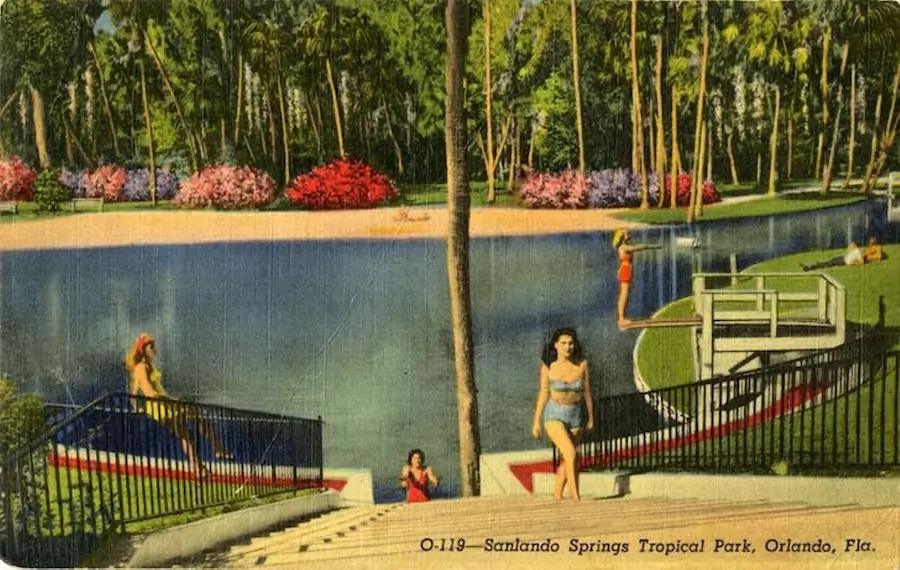
Long before anyone in Central Florida waited in line for a roller coaster, the hottest ticket around was a cold swim at Sanlando Springs. For decades, this spring west of Longwood was where locals went to beat the heat, climb the high dive, dance at the pavilion, and spend a whole Saturday for pocket change.
Then it vanished from public view. The water still bubbles up in the same spot, but it now sits behind a guarded gate off SR 434, and most folks who travel Sanlando Springs Road have never seen the place it's named after.
Here's the story of how a frontier watering hole named for Indiana became the region's favorite summer hangout, and how it ended up as one of Seminole County's best-kept secrets.
Table of Contents
Here's Sanlando Springs at a Glance
- Where it is: Inside The Springs, a gated community at 400 Woodbridge Road, west of Longwood in unincorporated Seminole County
- What it is: A second-magnitude spring that feeds the Little Wekiva River
- Original name: Hoosier Springs
- Public years: Roughly the mid-1920s through 1970
- Can you swim there? Only if you live there or know someone who does
A Florida Spring With an Indiana Nickname
The spring's fan club goes way back. People used the Wekiva basin for thousands of years, and surveys across the region have turned up middens, mounds, pottery, and shell dating from the Paleo-Indian era onward. Seminole County's marker notes that Indigenous people visited these springs long before settlers showed up.
In the 1870s, a wagon route between Longwood and Apopka rolled right past the water. Ingram Fletcher, an Indiana native, named the place after his home state: Hoosier Springs. He platted land there in 1885, then in January 1887 sold his 161-acre homestead to Elizabeth McLean Saunders, whose own development became linked with neighboring Palm Springs.
By 1887, the Florida Midland Railroad had followed the old wagon trail and kept a stop within walking distance of the spring. A refreshing dip no longer required a mule and a lot of patience.
The Spring Has Siblings
Hoosier was never an only child. It sits in a trio with Palm Springs and Shepherds Spring, which was later renamed Starbuck. All three help feed the Little Wekiva River, which flows on to the larger Wekiva and, eventually, the St. Johns.
The Name That Split the Difference
Enter James Franklin Haithcox, a developer and former Altamonte Springs mayor with big ideas. He picked up the property in the mid-1920s. Sources can't agree whether it was 1924 or 1925, but they all agree he's the guy who gave it a new name.
His marketing math was pretty clever. Take "San" from Sanford, tack on "lando" from Orlando, and presto: a destination perfectly positioned between the two cities. He marketed roughly 2,000 acres around Palm and Sanlando Springs, including a residential vision with a very 1920s name, "Sanlando: The Suburb Beautiful."
The name also landed on the map. In 1926, Warren Street was extended west from Longwood along old Florida Midland right-of-way to reach the attraction, and it became Sanlando Springs Road. Official maps still use that name for the SR 434 corridor through Longwood, which means the old resort has been hiding in plain sight on local maps for about a century.
Concrete, a Dam, and a Hotel That Never Checked In a Guest
Haithcox gave the rustic spring a serious glow-up. His 1926 improvements included concrete walks and steps, a bigger bathing area, a dam to raise the water level, a lawn, bathhouse facilities, and a separate swimming pool refilled with spring water. Crews even kept the clear spring water separate from the tea-colored river.
Ground was broken that year for a 50-room hotel, and plenty of online retellings say it opened. The most detailed local history of the spring says otherwise. The hotel was never finished.
The business model had a few surprises, too. Wandering the grounds was reportedly free, while the bathhouse and pool cost extra. For a short stretch, the pool house even had slot machines. By 1930, they were gone.
Boom, Bust, and a Beach Built From Scratch
The party hit a wall when the Florida land boom collapsed and the Great Depression arrived. Haithcox's plans sank, and the property went back to Moses Overstreet, the financier and landowner whose company had supplied or financed much of the acreage.
Luckily, Overstreet had plans of his own. He rerouted the Little Wekiva around the swimming area, built a broad sandy beach, and planted thousands of azaleas. Water lilies floated in ornamental pools. The real showstopper was a terrazzo dance floor under an oak tree wired with speakers, which might be the most Florida dance club ever designed.
The revamped park reopened in the mid-1930s as Sanlando Springs Tropical Park, proudly billed as "the playground of Central Florida." Vintage postcards bragged about its tropical beauty and freshwater bathing, and a circa-1947 brochure featured it among 31 top attractions across the state.
It soon stole the spotlight from nearby Palm Springs. Overstreet's response in 1944? He bought Palm Springs, too, with plans to combine the two into one bigger recreation complex.
Summers at the Playground of Central Florida
For generations, "Let's go to Sanlando Springs" was the go-to summer plan for local families. Picnic blankets covered the lawn. Kids charged off the sandy beach into 72-degree water, the temperature everybody quoted for decades and the same figure printed on the county's marker. After sundown, the dance floor under the oak took over.
The park served up swimming with a side of spectacle:
- Logrolling: The Marchand family put on contests and exhibitions in 1941.
- Pageants: Peggy Creel was crowned "Mrs. Sanlando Springs" on August 25, 1951.
- Big thrills: A high dive, a diving platform, and a towering slide that shot swimmers down toward the spring.
Swing Shifts on the Dance Floor
During World War II, buses brought military personnel from Central Florida bases straight to the park. Servicemen from places like the Sanford Naval Air Station met up with local young people at the evening dances, and the pavilion turned into one of the busiest social scenes around.
A Whole Day for 35 Cents
The best part might have been the price. In an Orlando Memory oral history, Betty Robinson remembered paying 35 cents to get in.
In 1950, J. E. Robinson and his wife bought the park. Their era added or expanded the high dive, the diving platform, and that famous slide, keeping the place near the top of every summer to-do list for the next two decades. Longtime locals still swap stories about the generations of families who grew up cannonballing there.
Greater Orlando's Water Park Before Water Parks Existed
Back before air conditioning was standard in local homes, springs were Central Florida's water parks. Sanlando Springs packed shade, sand, cold water, slides, dances, and landscaped "tropical" scenery into an easy outing from Orlando, Sanford, Longwood, and Altamonte Springs.
Here's the plot twist that explains what came next. It was never a public park. Sanlando Springs was privately owned and simply opened its doors to the public, first through facility charges and later through admission fees. Unlike Wekiwa Springs State Park, closing it didn't take a government vote. It just took a buyer.
1970: The Final Cannonball
In 1970, the park welcomed the public for the last time. Earl Downs and LNC Land Sales bought Sanlando, Palm, and Shepherds springs. Shepherds became Starbuck, and all three became the heart of a gated development called The Springs.
Construction kicked off in 1971, and the neighborhood grew to about 400 acres, with homes arranged around the preserved spring, woods, a clubhouse, trails, recreation facilities, and equestrian amenities.
After decades of summer crowds, one of the region's homegrown summer traditions locked its gates for good.
What's Hiding Behind the Gate
The high dive, the diving board, and the giant slide are long gone. Still, the spring keeps much of its old resort shape. The St. Johns River Water Management District describes water flowing mostly from an oblong cavity beneath a limestone ledge about seven feet below the surface, a spring pool roughly 30 feet across, and a dammed, oval swimming pond about 200 by 180 feet. Retaining walls hold the shape, and two weirs send the flow west into the Little Wekiva.
The Concert That Outgrew the Venue
For more than 20 years, the Orlando Philharmonic Orchestra's concert at The Springs gave the rest of us a ticketed peek inside. The event kept hitting capacity, so the orchestra announced a move to a larger venue starting in 2025. That once-a-year backstage pass is no longer on the calendar.
The Case of the Missing Marker
Seminole County once had a historical marker beside Markham Woods Road telling the story of Hoosier/Sanlando, Palm, and Shepherds/Starbuck springs. The Historical Marker Database now lists it as missing, so for most locals, old photos and online archives are the best way to visit Sanlando Springs today.
The Water Still Has a Job to Do
The pool parties wrapped up in 1970, but the spring never clocked out. The water management district tracks Sanlando Springs as part of its spring monitoring and minimum-flow work for the Wekiva and Little Wekiva basin, and there's good reason to keep an eye on it. Regional environmental studies have noted declining flows at Sanlando, Palm, and Starbuck springs since the early 1970s. The Little Wekiva drains a heavily urbanized basin with a history of stormwater and wastewater problems, and the cleaner water from these springs helps dilute it.
A gate can keep out crowds, but it can't keep out groundwater withdrawals, stormwater runoff, or suburban land use. The health of Sanlando Springs depends on the whole Wekiva springshed, which covers a lot more ground than one neighborhood.
Common Mix-Ups, Cleared Up
- Sanlando Springs vs. Sanlando Park: Sanlando Park is a Seminole County sports and tennis complex near Lake Mary. The historic spring sits inside The Springs, west of Longwood.
- One name, three meanings: Sanlando Springs can refer to the spring itself, the old Tropical Park, or the surrounding unincorporated community.
The Park Closed, but the Name Stuck Around
Hoosier Springs became Sanlando Tropical Park, which became The Springs. In about a century, it went from railroad stop to summer playground to private amenity.
The name, however, refused to retire. It lives on along SR 434, in Seminole County's community designation, and in the memories of every Central Floridian who ever handed over a few coins to jump in.
Meanwhile, the water keeps doing what it's always done, rising cool from under the limestone and drifting off toward the Little Wekiva.
🔥 If you're fascinated by Orlando history like I am, well, there's plenty more where this came from, right here.
Sources:
https://citruslandfl.blogspot.com/2017/04/blog-series-central-florida-would-be.html
https://historiclongwood.com/sanlando-hoosier-springs/
https://www.floridamemory.com/items/show/334279
https://www.floridamemory.com/items/show/70620
https://orlandomemory.org/topics/oral-history-interview-with-betty-robinson/
https://www.orlandoweekly.com/arts/remembering-sanlando-springs-orlandos-original-summer-hangout-spot-30947238/
https://www.sjrwmd.com/waterways/springs/sanlando/
https://orlandophil.org/orlando-philharmonic-orchestra-announces-the-inaugural-rockin-at-the-roost-concert-in-april-2025-featuring-the-music-of-fleetwood-mac/
https://www.hmdb.org/m.asp?m=214435
https://www.wekivawildandscenicriversystem.com/wp-content/uploads/2021/11/Wekiva_EA_final_9-30-11.pdf