Imagine East Colonial Drive at two in the morning on a Saturday in 1967: thin traffic, a small city, and the lights still on at Uncle John's Pancake House. Thirty-nine kinds of pancakes. A griddle that ran until 3:00 a.m. on weekends.
An all-you-can-eat stack for 49 cents. For a generation of Orlandoans who grew up here in the 1960s, none of that registered as a gimmick. It was Sunday. It was where your parents hauled you after church, after a movie, or for no particular reason at all.
And today the building has been other things for so long that most people in this city have never heard the name.
Table of Contents
What Made Uncle John's Pancake House an Orlando Late-Night Staple
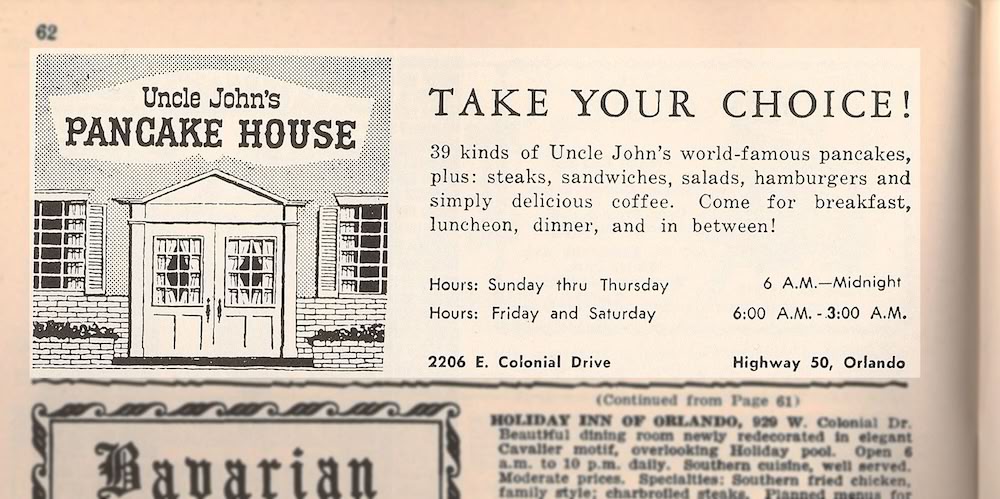
The Orlando Uncle John's Pancake House sat at 2206 East Colonial Drive, which most of us just call Highway 50, about a block west of Bumby Avenue in a stretch of town that would not pick up its current neighborhood branding for decades. A 1967 advertisement in a booklet called The Attractions of Orlando and Winter Park ran under an all-caps command, TAKE YOUR CHOICE, and then delivered: 39 kinds of what the copy billed as world-famous pancakes, plus steaks, sandwiches, salads, hamburgers, and coffee the ad promised was simply delicious. Breakfast, luncheon, dinner, and in between.
The hours were the real flex. Doors opened at 6:00 a.m. daily. Sunday through Thursday the kitchen ran to midnight. Friday and Saturday it stayed lit until 3:00 a.m.
That 39 is worth pausing on, because most write-ups of this restaurant say 20. The lower figure traces back to a single line of blog commentary from 2015, not to the ad, which plainly says 39. And it was not Orlando puffery. An Uncle John's that opened in Reno in February 1960 advertised the same 39 varieties, running to flavors like Iowa Corn and African banana.
Sit with those weekend hours for a moment. Three in the morning. In 1967. Long before 24-hour drive-thrus and convenience stores lined Colonial, the list of places to eat in this city after midnight was short enough to recite from memory, and Uncle John's Pancake House sat near the top of it, which made it a clubhouse for shift workers, teenagers stretching a Friday night to its absolute limit, and anybody whose dinner hour landed after most kitchens had already mopped the floors.
Then there was the headline act, named with a wink at the Gold Rush. The Forty-Niners Special: all-you-can-eat pancakes, 49 cents. Orlandoans who ate them as kids still bring the deal up unprompted in local history groups more than half a century later. Inflation eventually caught up and the price climbed to 69 cents, a hike that longtime customers apparently filed under personal betrayal. The room itself gets remembered as calm rather than crowded. Wander in on a weekday afternoon and the booths were yours to pick from. It carried a national name and behaved like a neighborhood joint.
How a Dairy Queen Owner Built a Pancake Empire
Orlando's Uncle John's Pancake House was one node in a much bigger network, and that network traces back to a World War II veteran named Jack Holder.
Holder was running a Dairy Queen in Oregon when he and his wife, Anne, decided to sell it and bet on something of their own. They moved to the Santa Clara Valley, still known then as the Valley of Heart's Delight for the orchards blanketing it, and opened the first Uncle John's Pancake House in Santa Clara on December 29, 1957. Some accounts push the origin back a year, to a 1956 debut in Santa Barbara, and the record is murky enough that both versions still float around. What nobody disputes is the momentum. Holder expanded into Millbrae, San Jose, and Palo Alto, and then the concept hopped state lines and kept going.
By 1961, roughly 60 Uncle John's restaurants were running across more than 20 states, making it one of the biggest pancake operations in the country and, for a stretch, close enough behind IHOP to be breathing on its neck. Franchising did most of the heavy lifting. Documented locations turned up in Ohio, Pennsylvania, Michigan, Texas, Nevada, Arizona, and Florida, which is how a California griddle concept wound up serving 3:00 a.m. short stacks on Colonial Drive.
Why Pancake Houses Multiplied So Quickly
None of this happened because one founder was unusually charming. Uncle John's Pancake House rode a real national craze for restaurants built around a single food, and pancakes turned out to be close to ideal franchise material.
The appeal was arithmetic. Flour, eggs, and syrup cost almost nothing. Nobody had to recruit a trained chef to work a griddle. Food costs at pancake houses could sit as low as 35 percent of revenue, against as much as 48 percent at a full-service restaurant, and that gap is exactly what let an operator advertise 49-cent unlimited pancakes and still go home happy.
Competition showed up fast. The International House of Pancakes was scaling at the same time, and Aunt Jemima's Pancake House had opened inside Disneyland back in 1955, which gave the whole format a glossy, respectable sheen. For a few years, opening a pancake house looked like one of the safer bets in the American restaurant business, and hundreds of operators took the swing. Orlando, growing steadily and full of young families, was exactly the kind of market that arithmetic pointed toward.
The Fresno Franchisee and the Napkin
The strangest footnote in the chain's history belongs to a franchisee named Joe Desmond, who opened an Uncle John's in Fresno, California, in 1959.
Desmond ran his Uncle John's Pancake House well enough. His real legacy, though, came from a conversation that happened inside it. He cut a deal with Colonel Harland Sanders and became one of the earliest Kentucky Fried Chicken franchisees, and the agreement was reportedly scratched out on the back of a napkin at one of Desmond's own tables. A pancake house in Fresno, in other words, helped set one of the biggest fast-food brands on earth in motion.
What Happened to the Orlando Restaurant
Here the trail goes cold, and it goes cold in a way that says a lot about how casually a city can misplace its own landmarks.
There is no clear public record of the year Uncle John's Pancake House closed in Orlando. No farewell write-up. No last-day photos. No preservation fight, no plaque, nothing. When a local history blogger revisited the East Colonial site in 2015 to write about that 1967 ad, the restaurant had been gone so long that the building had already spent decades as something else.
For part of that run it housed a chiropractic and alternative medicine practice, which is about as ordinary a second act as a mid-century commercial building on Colonial can have.
Orlandoans chasing a comparable breakfast on this stretch now generally land at the IHOP at 647 East Colonial Drive, roughly a mile west toward downtown, which is open 24 hours a day. The late-night pancake habit on Colonial survived, then, just under a different sign. Perfectly good pancakes. Not the same thing, and anyone who remembers the original will tell you so.
What makes the silence around the place so strange is how undramatic the ending was. Restaurants that burn down or get bulldozed for an interchange leave a paper trail. Restaurants that quietly stop renewing a lease do not. This one fed thousands of Orlando families and anchored a piece of Colonial Drive during the exact decade the city was deciding what it wanted to be, and nearly everything we know about its final years comes from people typing memories into Facebook groups.
Why the Chain Faded
The national collapse is documented about as thoroughly as the Orlando closure, which is to say barely. A chain of 60 restaurants shrank to a handful, and no single corporate record explains how.
The likeliest answer is unglamorous: the format aged out. Through the late 1960s and into the 1970s, pancake houses started padding their menus with steaks and full dinner entrees to chase customers who wanted more than breakfast. Orlando's own ad shows how early that hedging started. In 1967 this Uncle John's Pancake House was already selling steaks, hamburgers, and salads and inviting people in for luncheon and dinner, years before the category ran out of arguments. The moment that happened, the specialty pancake house lost its argument against the general family restaurant, and Denny's and Country Kitchen ate the category.
Food historians piecing together the story of Uncle John's Pancake House have had to work from scattered regional references, yellowing advertisements, and other people's childhoods rather than any tidy archive. The chain grew fast, franchised wide, and left almost no paperwork behind, which is a common fate for businesses that were everywhere right up until they were not.
Where the Uncle John's Pancake House Name Survives Today
The brand did not disappear entirely. It just does not live here anymore.
The most durable outpost is in Toledo, Ohio, where an Uncle John's Pancake House has served the same West Toledo neighborhood since 1963, changing addresses over the years without ever actually leaving, which makes it one of the longest continuously running pieces of the original chain anywhere in the country. Out in California's South Bay, new locations have opened in Campbell and San Jose as modern revivals of the concept. Those are separately owned reboots rather than direct descendants of the 1960s franchise network, but they are keeping the sign lit within a few miles of where Jack Holder started the whole thing.
Pennsylvania gets a chapter too. In the central part of that state, the Uncle John's Pancake House operation was run by Elsie Mueller Davenport, part of the family behind Davenport Restaurants and a set of local Bob's Big Boy franchises, a reminder of how much regional restaurant history runs through a handful of busy families.
Worth Remembering
Orlando has never been especially sentimental about its buildings. Growth showed up early, often, and with a bulldozer, and plenty of places residents genuinely loved got replaced without so much as a going-away card.
Uncle John's Pancake House earned better than total anonymity. It was a 1960s Orlando institution on East Colonial Drive that stayed open until 3:00 a.m. on weekends, sold unlimited pancakes for pocket change, and served a version of this city that existed before the interstates thickened and Colonial Drive filled in with everything standing on it today. The building is something else now. The Forty-Niners Special is not walking back through that door at any price.
But the story is still out there in circulation, carried by people who were kids in those booths and have never quite stopped talking about it. For a restaurant that left almost no records behind, that turns out to be a pretty respectable way to survive.
🔥 Love Orlando history like this? Well, there's plenty more where this came from, right here.
Sources:
https://orlandoretro.com/2015/02/17/orlando-retro-advertisement-1967-uncle-johns-pancake-house/
https://www.facebook.com/groups/grewupinorlando/posts/8494879200563223/
https://thisisreno.com/2020/04/day-30-pancakes/
https://jackholders.com/about-us/
https://restaurant-ingthroughhistory.com/category/chain-restaurants/page/2/
http://www.brokenchains.blog/2018/12/uncle-johns-stand.html
https://restaurant-ingthroughhistory.com/category/family-restaurants/
https://jemmanagement.com/joe-desmond-founder/
https://www.mashed.com/1900950/uncle-johns-pancake-house-locations-ohio-california-local/
https://www.13abc.com/2023/03/27/officially-closing-day-uncle-johns-pancake-house-new-location-expected-open-july-2023/
https://unclejohnspancakehouse.com/
https://www.pennlive.com/food/2014/05/uncle_johns_pancake_house_thro.html