
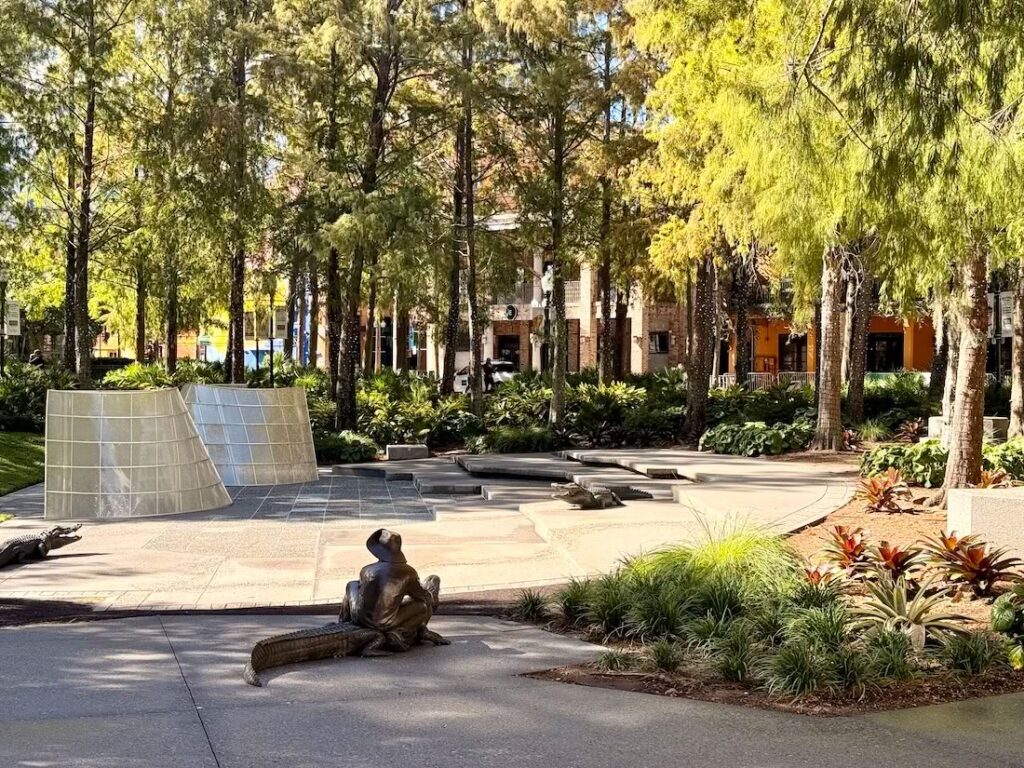
Grab a coffee on Central Boulevard, miss the Lymmo, stumble out of a bar on Wall Street, and odds are you’ve marched right across the most important patch of dirt in the city without a glance down. Heritage Square, that leafy two-block green space parked in front of the Orange County Regional History Center, looks like a perfectly nice spot to eat a sandwich under a cypress tree. It is. But it’s also, no exaggeration, the exact point from which Orlando was first measured, mapped, and dreamed into being.
Whether you’ve lived here for decades or just unpacked the last box, Heritage Square is worth a second look. Its backstory has everything: a deserted log cabin, a clock tower nicknamed “Big Ben,” a notorious murder trial, a buried time capsule, and a memorial that will stop you cold.
Here’s the twisty history of Heritage Square hiding behind that fountain.
Table of Contents
Where Orlando Began: 1857
This little square of grass carries more history than any other plot in town, and it’s not even close. In October 1857, right after the U.S. Post Office officially blessed the name “Orlando,” Alabama businessman B.F. Caldwell donated four acres at the corner of Central Boulevard and Magnolia Avenue for a courthouse. A plaque on the site still lays it out: "it was from this very corner that the city limits of Orlando, originally just one and one-half miles square, were first platted."
Translation: the ground under Heritage Square is ground zero. Surveyors stood here and used this spot as the anchor for the whole baby town, every street and early property line fanning out from the dirt now napping under the park’s trees. And lest you picture something grand, this was raw frontier Florida, where razorback hogs reportedly wandered up to scratch their backs against the wooden courthouse steps. Very on-brand for early Orlando.
Six Courthouses, One Stubborn Corner
The truly remarkable part is how many times Orange County kept rebuilding on this exact spot, like a contractor who refuses to move on. Over roughly 140 years, a succession of courthouses rose, burned, crumbled, or got knocked down right here, each one a perfect time capsule of its era. The land that is now Heritage Square cycled through all of them:
- 1857 to 1863: A deserted two-room log cabin on Church Street pulled temp duty as the courthouse, because the budget was, let’s say, tight.
- 1863: A two-story hand-hewn log structure finally went up on the donated land, then promptly burned down in 1868.
- 1875: Augustus Hyer built a three-story frame courthouse to replace it.
- 1882: W.C. Green’s Company put up yet another one, this time designed by architect A.S. Wagner.
- 1892: The showstopper. A grand red-brick, three-story Gothic Revival building with an 80-foot clock tower the locals affectionately dubbed “Big Ben.”
That 1892 brownstone deserves a moment. Its clock movement was built by Dent of London, the same firm behind the real Big Ben mechanism across the pond, so Orlando was basically flexing. The kicker: its 1,500-pound bell still survives inside the lobby of the current Orange County Courthouse. Not a bad retirement gig for a building gone for decades.
The 1927 Courthouse That Became the History Center
By the 1920s, the Victorian courthouse simply couldn’t keep up with a county that was exploding. So Orange County bought more land in 1924 and hired Murry S. King, Florida’s first registered architect, to design something grand in the Neoclassical Revival, or Beaux Arts, style. Then came the plot twist: King died suddenly in 1925 before finishing. His son, James R. King, completed the job, and the courthouse was dedicated on October 12, 1927, at 50 North Magnolia Avenue. For decades, it was the undisputed star of downtown.
The older 1892 brownstone next door didn’t go quietly. It kept housing county offices, and by 1942 the community had stuffed it with a pioneer-era history exhibit, which turned out to be the humble seed of the Orange County Regional History Center collection. When the brownstone was finally condemned and demolished in 1957, county commissioners formed an official historical commission to keep the preservation work going, a thread that ties the museum directly to the land at Heritage Square.
The 1927 building got a glorious second act after Orange County opened a shiny new high-rise courthouse in 1995. A task force of community leaders unanimously voted to turn the old beauty into a major regional museum. A $35 million renovation later, the History Center opened in September 2000. Today it’s a Smithsonian affiliate with five floors of exhibits covering everything from citrus and cattle to space exploration and Florida’s gloriously goofy tourism era.
The Aqua Annex, Ted Bundy, and a Buried Time Capsule
Now for the chapter most newcomers have never heard. The footprint of the demolished 1892 courthouse, basically the ground Heritage Square sits on now, got redeveloped into a gloriously loud, eight-story aqua-tiled annex. The cornerstone went down on October 12, 1959, and the $4 million International Style building opened on March 7, 1960, looking like the future.
Designed by architects Ralph P. Lovelock of Winter Park and James B. King of Orlando, the annex was pure mid-century swagger: yellow baked-on enamel elevator doors, stainless-steel fixtures, moveable office partitions, and a fifth-floor jail with a kitchen where inmates cooked meals for up to 165 prisoners. One newspaper gushed that the colorful tower had “injected a sprightly conversational wedge into downtown coffee breaks,” a delightfully 1960 way of saying people couldn’t stop talking about it.
The annex also saw some genuinely heavy history: Ted Bundy’s murder trial was held here in the 1980s. And here’s a fun one for your next trivia night, buried in the cornerstone during construction is a time capsule stuffed with 1950s artifacts, including a rubber stamp from Christmas, Florida, and 50 pennies, all set to be cracked open in 2059.
For all that strut, the building barely made it 40 years. Asbestos crept in, and by 1989 the county hauled out roughly 300 employees and 200 inmates. Full cleanup was pegged at a wallet-flattening $30 million, so only the lower three floors got scrubbed for temporary use while the new courthouse rose. The annex was demolished in 1998, and in 1999 the cleared site began its slow glow-up into the Heritage Square we love today.
How Heritage Square Park Was Designed
With the annex gone, Orange County called in landscape architecture firm Marquis Latimer + Halback to turn the 1.1-acre site into a proper public gathering place. The Heritage Square you stroll through today is their handiwork. Senior Principal Frederick Halback led the team, with architecture by Spillis Candela and Partners alongside Kha LeHuu Architects.
And they got clever with it. The design is rooted in the land’s deep past. The layout abstractly evokes a bald cypress dome and a natural spring, a nod to the swampy Florida landscape that was here long before Orlando was, while subtle touches tip their hat to the three earlier courthouses and the original platting of the city.
At the heart of it all sits a fountain plaza ringed by mature cypress trees and native plantings that, over two decades, have quietly become a legit urban oasis. The project also reworked the Wall Street Plaza pedestrian connection and tucked in a Lymmo transit stop for good measure.
The work even racked up hardware: an ASLA Florida Chapter Award of Excellence and an FPZA Outstanding Public Development Award. Proof this was thoughtful civic design, not a patch of sod tossed over an old demolition site.
Remembering July Perry
In June 2019, the park took on a far weightier kind of meaning. A historical marker was placed honoring July Perry, a victim of the Ocoee Massacre of November 3, 1920, the deadliest incident of Election Day violence in U.S. history. Perry was lynched after a white mob stormed his home looking for Mose Norman, a Black resident who had dared to exercise his right to vote.
The marker was unveiled on June 21, 2019, in a ceremony attended by Orange County Mayor Jerry L. Demings, the county’s first African American mayor, who drew a direct line between Perry’s sacrifice and his own ability to hold that office.
Placed in partnership with the Equal Justice Initiative’s Community Remembrance Project, the City of Orlando, and Orange County Government, the marker gives Heritage Square a role well beyond civic celebration: a place to reckon honestly with the region’s hardest chapters.
The Park Today, and How to Enjoy It
In late 2024, Heritage Square got a fresh coat of green, with around 3,600 new shrubs planted along Central Boulevard to lean harder into that native-Florida-spring vibe (and, candidly, to discourage loitering). The result is a tidier, lusher front door to downtown’s civic core.
These days, Heritage Square is basically downtown Orlando’s communal backyard, hosting concerts and gatherings for thousands of people. It plugs right into Wall Street Plaza, the pedestrian stretch toward Orange Avenue, making it the natural crossroads whether you’re museum-bound, bar-hopping, or just cutting through. And those cypress trees, now north of 20 years old, have become genuine local celebrities, regularly starring on the History Center’s social feeds.
Want to actually experience Heritage Square instead of speed-walking past it? Start inside the History Center for five floors of regional history, then head out and find the July Perry marker and the little nods to the long-gone courthouses. Then park yourself by the fountain for a few minutes. You’ll be sitting on the precise corner where someone once measured an entire city into existence. No big deal.
Why It Matters for Locals
Plenty of Orlandoans cruise past this corner every week and file it away as “that little park by the museum.” Understandable, but oh, how wrong. Few patches of land in Florida pack this much story per square foot. Heritage Square is the city’s literal starting line, the former seat of justice for six straight courthouses across more than a century and a half, the backdrop to a notorious trial, and now a living memorial to both Orlando’s founding and its most painful history.
So next time you’re downtown with a few minutes to kill, take the scenic route through it. Once you know what went down here, an ordinary green space turns into one of the most quietly remarkable spots in Central Florida, and a great reminder that the city you call home started right here.
🔥 Love Orlando history like this? Well, there's plenty more where this came from, right here.
Sources:
https://www.thehistorycenter.org/about/history-center/
https://ninthcircuit.org/about/history/orange-county-courthouses/1857
https://en.wikipedia.org/wiki/Murry_S._King
https://ninthcircuit.org/about/history/orange-county-courthouses/1960
https://orlandoretro.com/2013/04/13/orange-county-court-house-and-annex-orlando-fl-1960s/
https://www.halback.com/portfolio-projects/heritage-square
https://parkmagnet.com/united-states/florida/orlando/heritage-square-park
https://newsroom.ocfl.net/2019/06/historical-marker-to-be-placed-honoring-lynching-victim-july-perry/
https://www.thehistorycenter.org/plan-an-event/special-events/